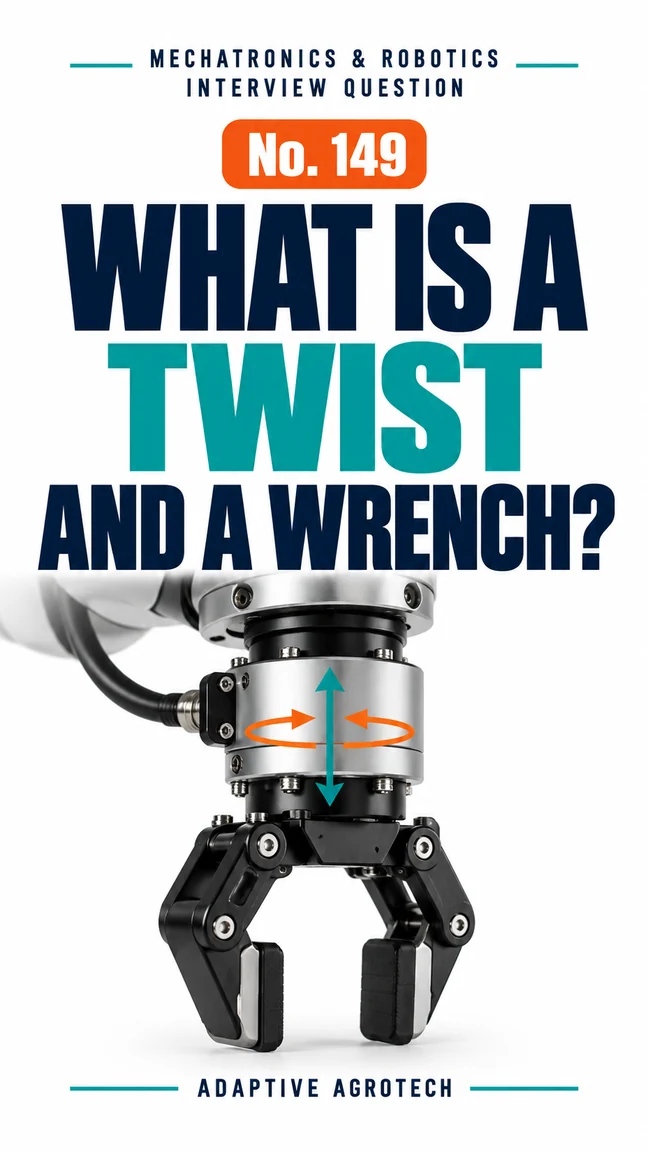
What Is the Difference Between a Twist and a Wrench?
A twist combines angular and linear velocity; a wrench combines moment and force. Compatible frames and reference conventions let their dot product express mechanical power, while off-center forces contribute moments.
The key idea
A twist describes rigid body motion with six components, using angular velocity followed by linear velocity in this lesson’s convention. A wrench describes mechanical effort, ordered as moment followed by force. A gripper can translate and rotate simultaneously, while contact force applied away from the chosen reference point creates a moment. Two newtons acting at a perpendicular distance of 0.3 meters produce 0.6 newton meters. With compatible frames and reference conventions, wrench dotted with twist gives instantaneous mechanical power. Changing reference points therefore requires transforming the moment as well as keeping the force description consistent.
What to remember
- Twists combine angular and linear velocity.
- Wrenches combine moment and force.
- Compatible wrench–twist pairing gives mechanical power.
Check your understanding
What moment results from 2 N at a perpendicular distance of 0.3 m?
Show the explanation
0.6 N m.