What Is the Difference Between Forward and Inverse Dynamics?
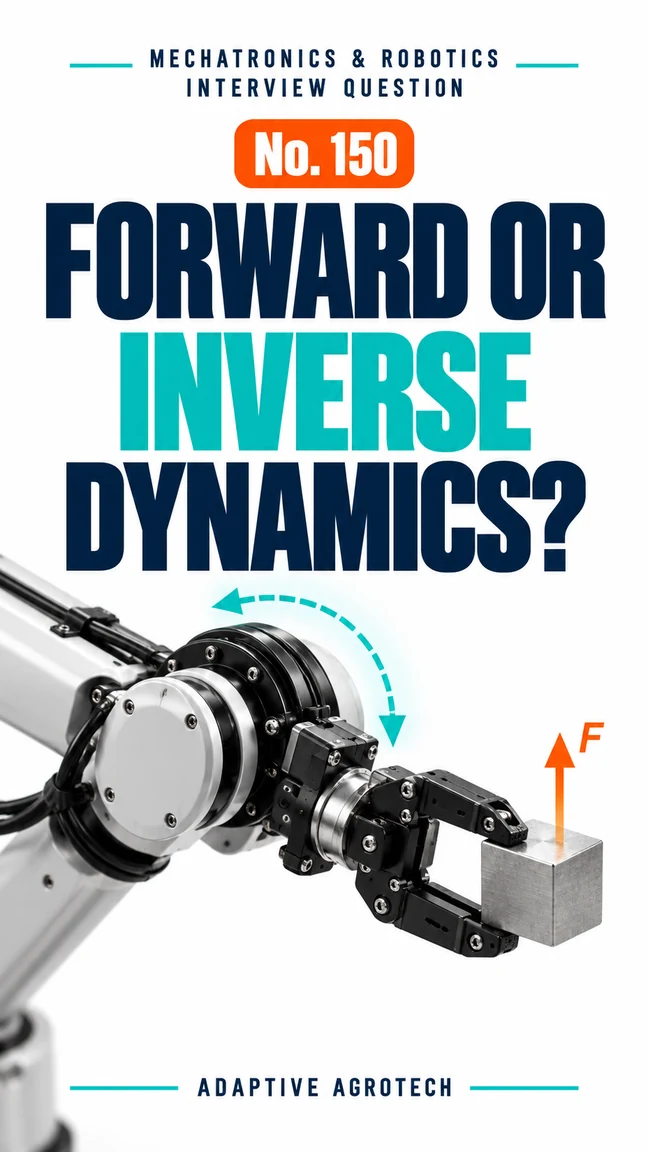
Forward dynamics predicts acceleration from applied torque and state, while inverse dynamics calculates torque for a requested acceleration. Both depend on a physical model whose payload, friction, and actuator assumptions affect real results.
The key idea
Forward dynamics uses current joint position, velocity, and applied torque to predict joint acceleration. Inverse dynamics uses that state and a requested acceleration to determine the needed torque. Both account for inertia, velocity dependent effects, and gravity. In the lesson’s ideal horizontal half meter link with a two kilogram point mass, gravity requires 9.81 newton meters, and one radian per second squared of upward acceleration adds 0.5 newton meters. Inverse dynamics thus requests 10.31 newton meters; forward dynamics would start from torque and solve for acceleration. Friction, payload errors, and saturation change actual motion.
What to remember
- Forward dynamics maps state and torque to acceleration.
- Inverse dynamics maps state and requested acceleration to torque.
- Model errors and torque limits affect physical results.
Check your understanding
Which dynamics problem finds the torque required for a requested acceleration?
Show the explanation
Inverse dynamics.