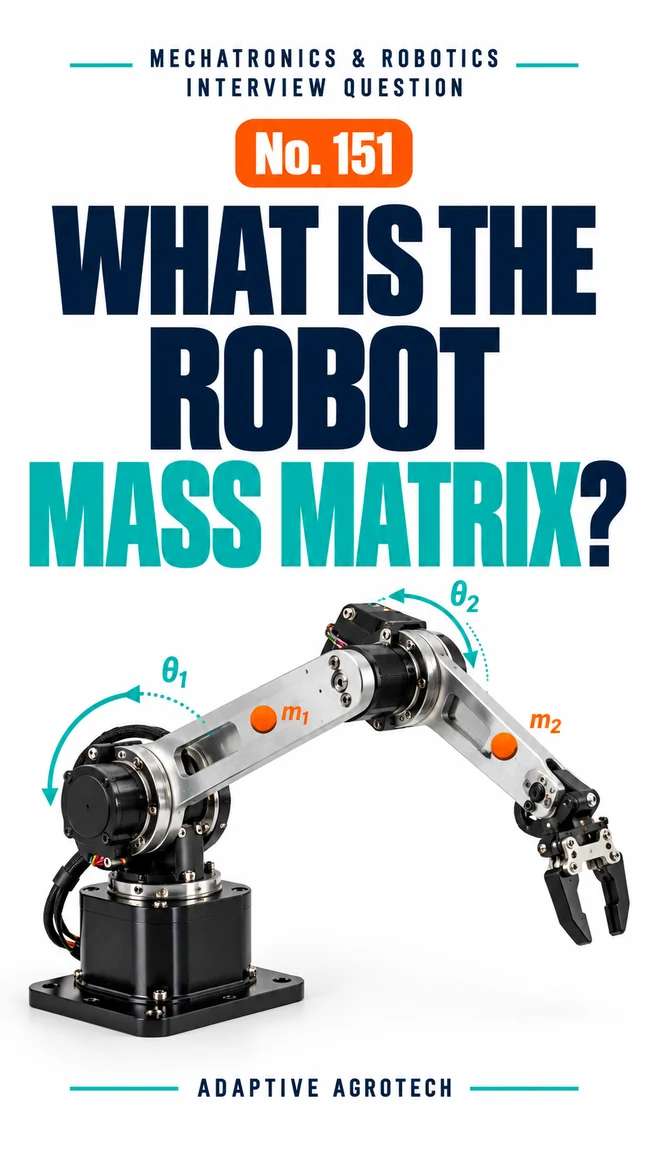
What Is the Robot Mass Matrix?
The robot mass matrix expresses configuration dependent inertia and coupling between joint accelerations and effort. It also defines kinetic energy, and a physically valid matrix in independent rigid robot coordinates is symmetric and positive definite.
The key idea
The mass matrix M(q) describes inertial joint effort associated with acceleration at the current configuration. It also gives kinetic energy through one half qdot transpose M(q) qdot. For independent coordinates of a physical rigid robot, this matrix is symmetric and positive definite. Its values change with posture: an extended two link arm has different inertial behavior from a folded one. Off diagonal terms represent dynamic coupling, meaning accelerating one joint can require torque at another before gravity is considered. Motion prediction and model based control therefore need the full configuration dependent matrix rather than a single mass value.
What to remember
- The mass matrix depends on joint configuration.
- Off diagonal terms express dynamic coupling.
- It defines kinetic energy and is symmetric positive definite under the stated model.
Check your understanding
What do off diagonal mass matrix terms describe?
Show the explanation
Dynamic coupling between joint accelerations and inertial effort at other joints.