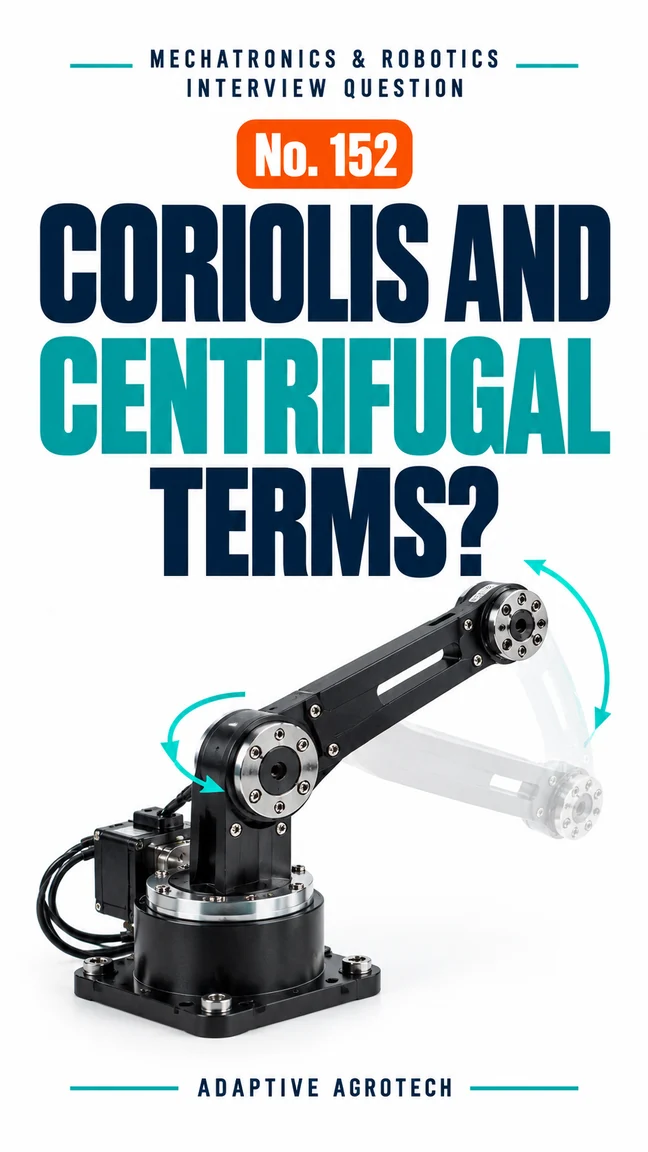
What Are Coriolis and Centrifugal Terms in Robot Dynamics?
Coriolis and centrifugal terms represent velocity dependent loads from coupled robot motion. They involve products and squares of joint speeds, scale quadratically in the ideal model, and remain distinct from gravity and friction.
The key idea
Robot links move through a coupled geometry, producing velocity dependent contributions often written as c(q, qdot), or C(q, qdot) qdot. Products of different joint speeds appear as Coriolis terms, while squared speeds appear as centrifugal terms in a chosen coordinate model. Their values and signs depend on configuration and motion, and they may assist or oppose a requested movement. At a fixed configuration, doubling all joint speeds multiplies the ideal quadratic velocity load by four. The combined vector represents the physical velocity load, while its C matrix factorization is not unique; gravity and friction require separate treatment.
What to remember
- Velocity products and squared speeds create these loads.
- Doubling all speeds at fixed posture gives four times the ideal terms.
- The combined vector matters; the C matrix is not unique.
Check your understanding
How do ideal quadratic velocity terms change if all joint speeds double at fixed configuration?
Show the explanation
They become four times as large.