What Is Gravity Compensation in a Robot Arm?
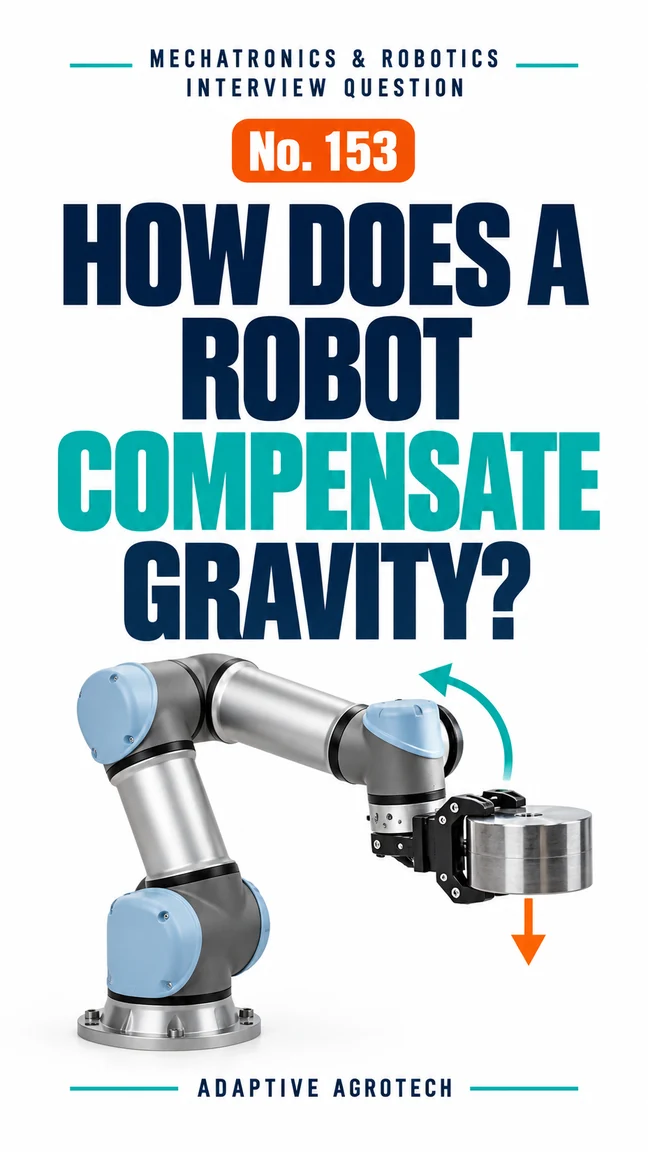
Gravity compensation commands torque to counter predicted gravitational loads. It depends on posture and mass distribution, can ease holding or guided movement, and leaves residual effects when payload estimates or other dynamics are inaccurate.
The key idea
Gravity compensation uses a robot model to command joint torques that balance gravitational loads. It can help an arm hold a pose or feel lighter during guided motion. A two kilogram point payload at the end of a horizontal half meter link requires approximately 9.81 newton meters at the pivot; as the ideal link approaches vertical, its gravitational moment arm and required torque approach zero. Real links contribute their own weight, and changing payloads or inaccurate centers of mass leave residual loads. Compensation does not remove inertia or friction, so feedback and suitable limits remain necessary.
What to remember
- Support torque varies with posture and mass distribution.
- Payload and center of mass errors leave residual gravity load.
- Gravity compensation does not cancel inertia or friction.
Check your understanding
Why does the ideal support torque approach zero as the link becomes vertical?
Show the explanation
The gravitational moment arm about the pivot approaches zero.