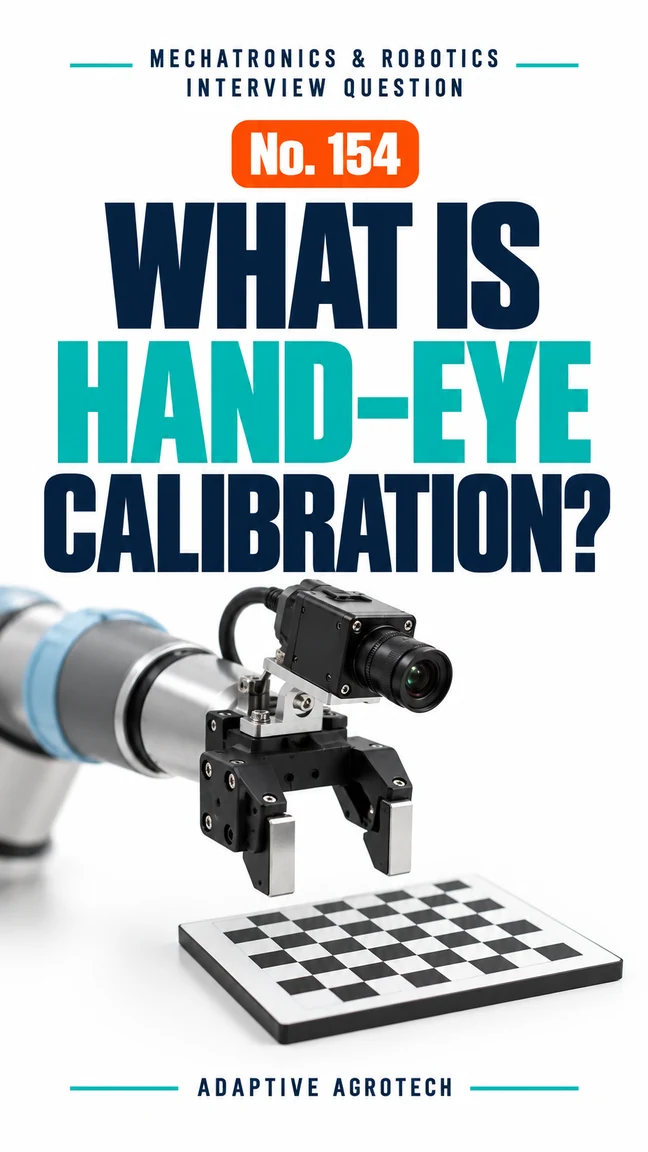
What Is Hand–Eye Calibration?
Hand–eye calibration estimates a fixed rigid relationship between camera and robot frames. Eye-in-hand observations across diverse robot poses constrain that transform, while synchronized measurements and validation on unused poses determine practical calibration quality.
The key idea
In an eye-in-hand setup, the camera is attached to the gripper, so its mounting transform remains fixed while the arm moves. Hand–eye calibration estimates that rigid camera to gripper relationship. The gripper visits multiple poses while observing a stationary calibration target; robot kinematics measures gripper motion and vision estimates target motion relative to the camera. A common formulation links relative motions through AX = XB, with X as the unknown mounting transform. Diverse rotations are more informative than repeated motion about one axis. Camera calibration, synchronized measurements, and validation at poses outside the estimation set affect reliability.
What to remember
- Estimate the fixed camera mounting transform.
- Use robot and visual relative motions in AX = XB.
- Collect diverse rotations and validate with unseen poses.
Check your understanding
Why should calibration include diverse rotations?
Show the explanation
Repeated movement about one axis provides less informative motion for estimating the fixed transform.