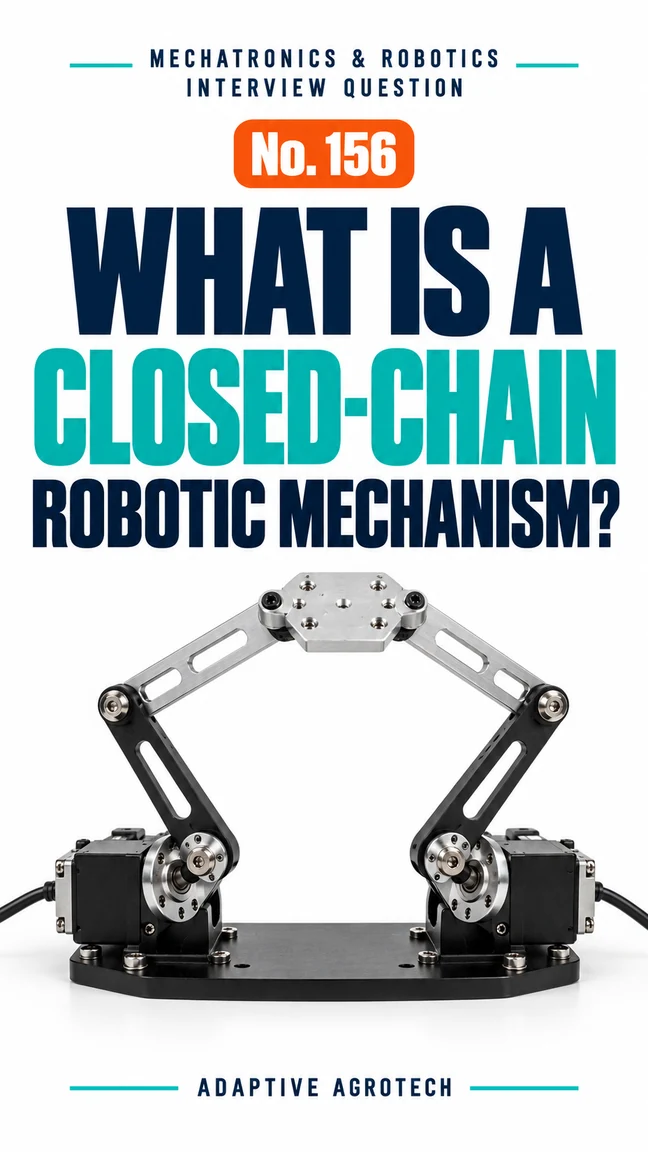
What Is a Closed-Chain Robotic Mechanism?
A closed-chain mechanism contains a loop of linked joints, creating closure constraints between coordinates. Its joints cannot all be commanded independently, and valid motion must account for assembly modes and singular configurations.
The key idea
A closed kinematic chain lets a path through links and joints return to its starting link. This loop imposes geometric closure constraints that couple the joint coordinates. A planar four-bar linkage with one fixed link and four revolute joints typically has one degree of freedom in a regular configuration: moving the input crank determines compatible positions for the remaining links. Parallel robots use related loops to support moving platforms. Controllers must preserve closure rather than assign every joint angle independently, and motion checks must consider multiple assembly modes and singular configurations throughout the path.
What to remember
- Kinematic loops impose geometric closure constraints.
- A regular planar four-bar typically has one independent coordinate.
- Commands must preserve closure across the motion.
Check your understanding
Why can a controller not choose all closed-chain joint angles independently?
Show the explanation
The joint values must satisfy the geometric constraints that keep the loop closed.