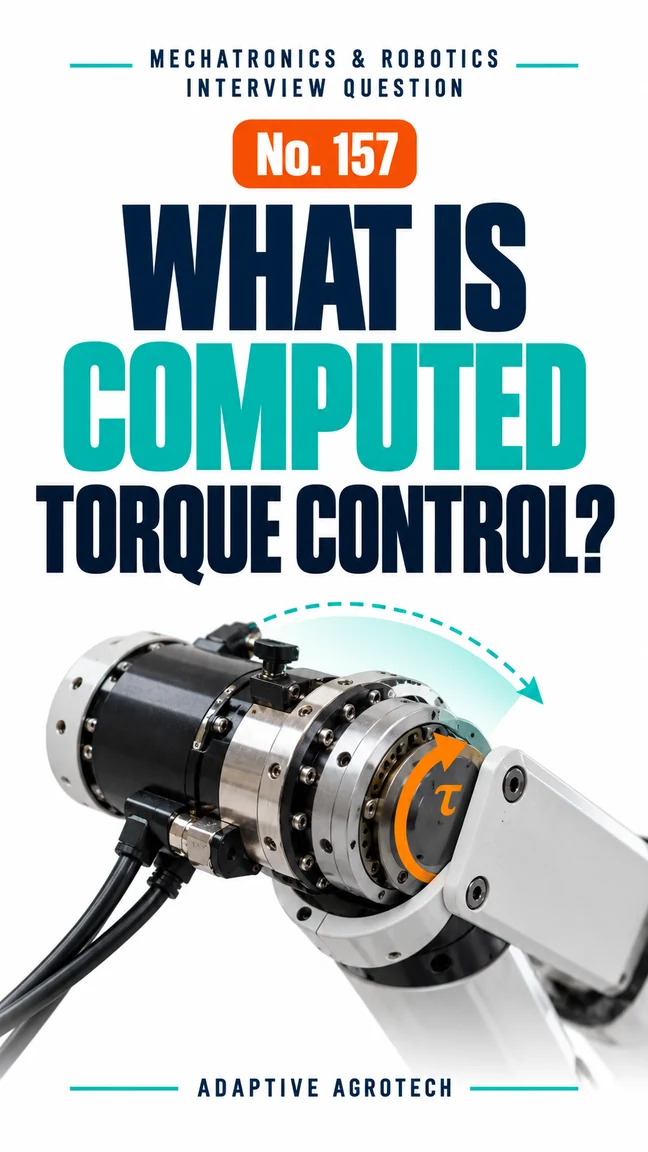
What Is Computed Torque Control?
Computed torque control combines a robot dynamics model with tracking feedback to request joint torque. Ideal model cancellation can simplify error dynamics, while real payload errors, friction, and saturation limit the result.
The key idea
Computed torque control converts a desired joint acceleration into torque using a dynamics model, while position and velocity feedback correct tracking errors. For a lifting joint, the model predicts inertial, gravity, and velocity dependent torque contributions before a large error develops. With an exact model, the resulting error dynamics can be linear. Real behavior differs when payload estimates are wrong, friction is unmodeled, or actuator torque saturates. Use feasible trajectories with torque reserve, compare predicted and measured motion, and verify operation across the intended range rather than relying on ideal cancellation alone.
What to remember
- Combine dynamics compensation with position and velocity feedback.
- An exact model can give linear error dynamics.
- Model error and torque saturation undermine ideal cancellation.
Check your understanding
What can spoil computed torque control’s ideal cancellation?
Show the explanation
Payload errors, friction, and torque saturation are examples.