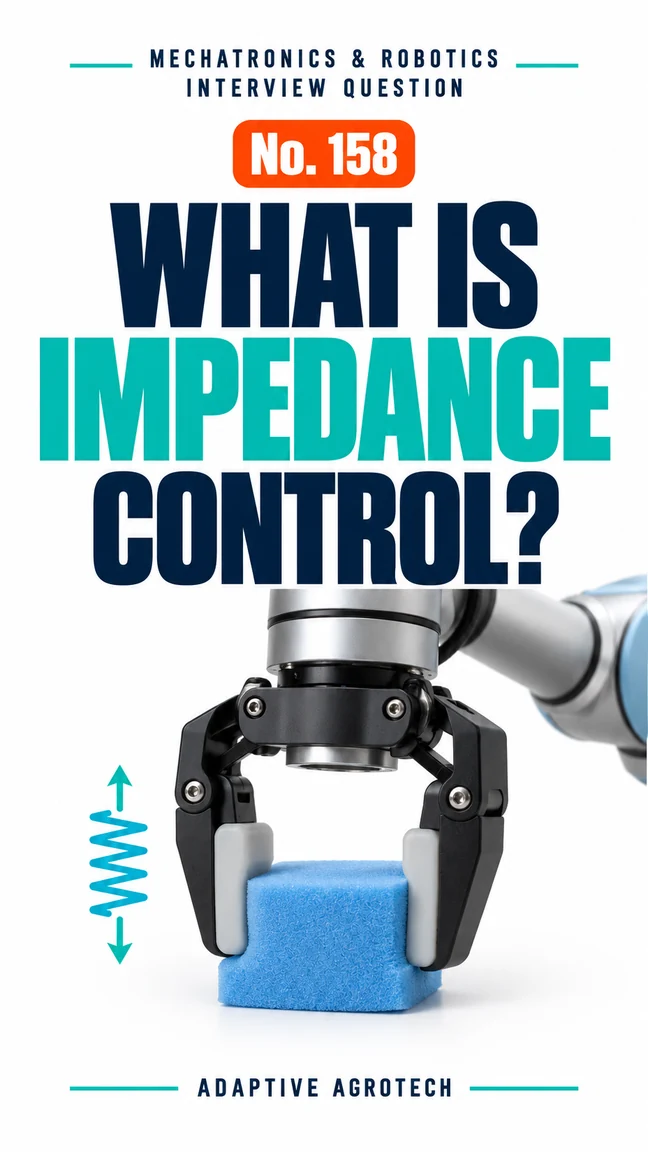
What Is Impedance Control?
Impedance control shapes interaction by relating motion error to commanded force or torque. Virtual stiffness and damping create compliant behavior, but stability depends on the complete actuator, sensing, delay, and environment dynamics.
The key idea
Impedance control sets a desired force–motion relationship, often resembling a virtual mass, spring, and damper. Motion error determines the force or torque command. For a robot polishing a surface, lower virtual stiffness permits greater deflection under the same contact force, while damping helps limit oscillation when the surface changes. The chosen settings must suit the actual actuators, sensors, and environment. High stiffness combined with delay can destabilize contact. A compliant feel alone therefore does not establish a safety rating or stable interaction with every surface; assess the full robot–environment loop.
What to remember
- Motion error produces an effort command.
- Virtual stiffness and damping shape compliant response.
- Delay and environment dynamics influence stability.
Check your understanding
What happens with lower virtual stiffness under the same contact force?
Show the explanation
The robot allows greater deflection.