What Is Admittance Control?
Admittance control turns measured interaction force into a motion reference through virtual dynamics. An inner motion loop follows that reference, while force bias, delay, and practical motion limits strongly influence resulting behavior.
The key idea
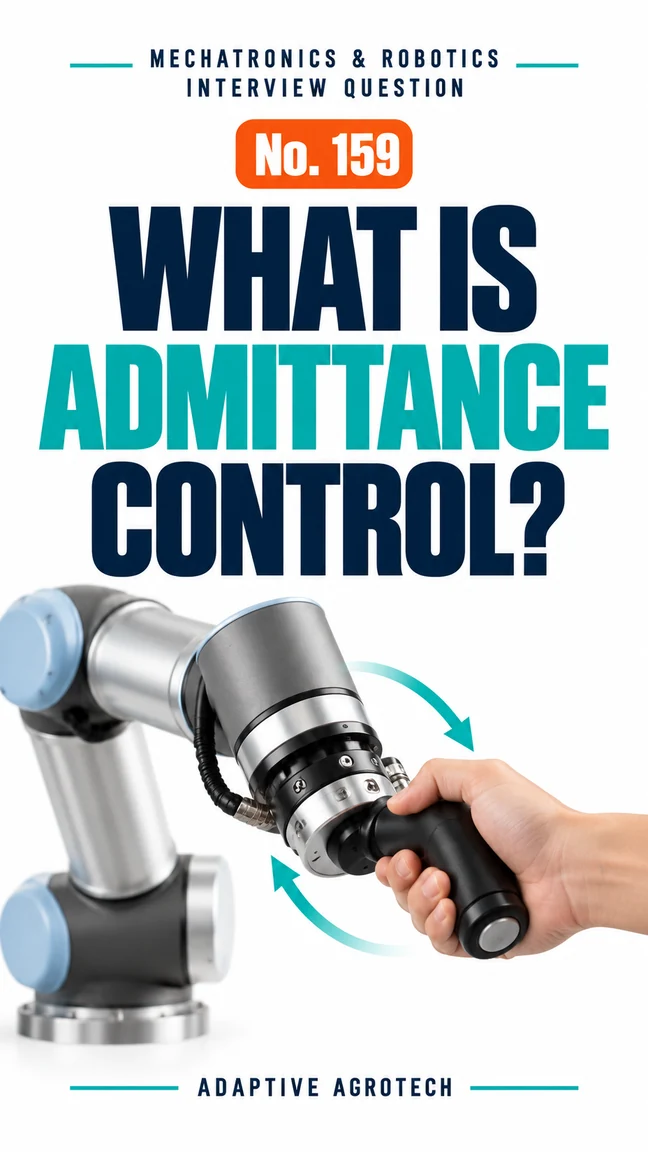
An admittance controller takes measured interaction force and computes a commanded displacement or velocity using a virtual mass, damper, and spring. An inner motion controller then tracks that reference. For hand guiding, pushing a force-sensing handle produces a smooth robot movement command. In a mass and damper model without stiffness, increasing virtual damping reduces the steady speed for a fixed applied force. Sensor bias, gravity compensation, filtering, and inner loop delay affect physical behavior, and force offsets can create drift. The complete interaction needs testing with practical motion limits and a deliberate stopping strategy.
What to remember
- Measured force generates a commanded motion reference.
- Virtual dynamics determine how the robot yields.
- Force offsets can produce drift and require careful handling.
Check your understanding
In a mass–damper admittance model, how does greater damping affect steady speed for the same force?
Show the explanation
It lowers the steady speed.