What Is the Difference Between Impedance and Admittance Control?
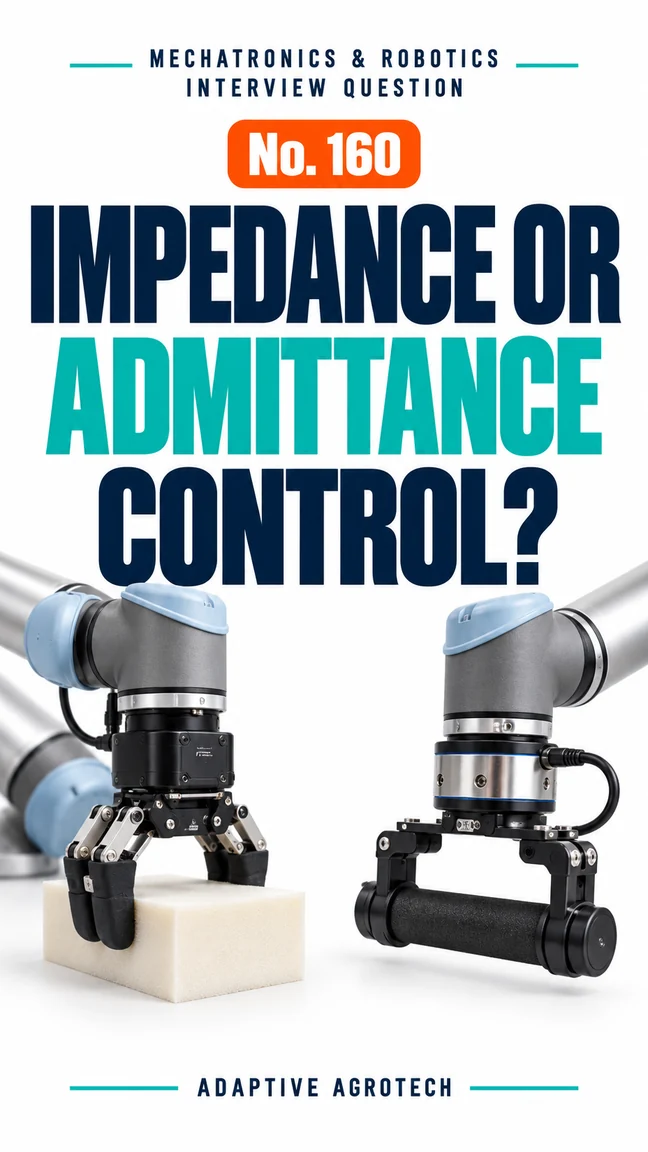
Impedance maps motion error to effort, while admittance maps measured force to a motion reference. Their implementations suit different robot command interfaces, and ideal mathematical inversion does not make real closed-loop behavior interchangeable.
The key idea
An impedance controller uses motion error to request force or torque, whereas an admittance controller uses measured force to generate a motion reference. A torque controlled robot can directly shape interaction impedance; a robot with a strong inner position loop often uses an outer admittance model. Both architectures can produce compliant contact, but they require different sensing and command interfaces. Although the relationships are mathematical inverses in ideal linear models, real actuator bandwidth, force sensing, delay, and environment stiffness govern their behavior. Evaluate the complete closed loop rather than choosing by controller name alone.
What to remember
- Impedance maps motion error to force or torque.
- Admittance maps measured force to a motion reference.
- Hardware interfaces and complete loop dynamics determine behavior.
Check your understanding
Which architecture commonly wraps a strong inner position loop?
Show the explanation
An outer admittance model that converts measured force into a motion reference.