What Is Operational Space Control?
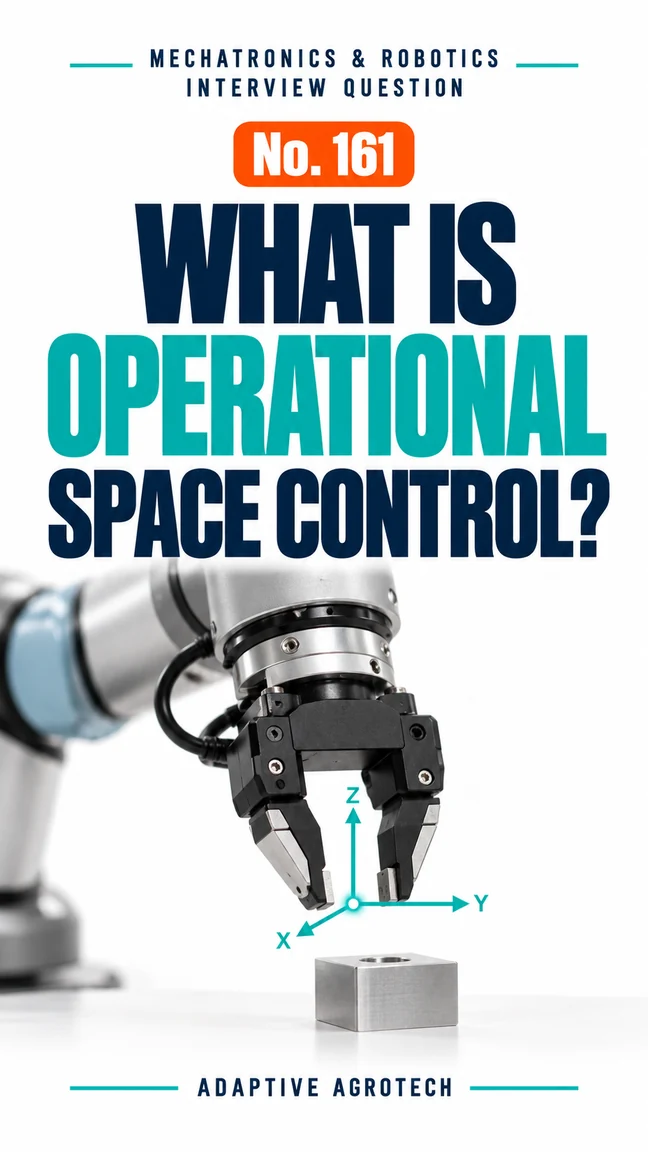
Operational space control describes robot dynamics in task coordinates, such as tool position. Instead of choosing joint motions independently, the controller computes the end effector force needed for a desired task acceleration.
The key idea
Operational space control describes robot dynamics in task coordinates, such as tool position. Instead of choosing joint motions independently, the controller computes the end effector force needed for a desired task acceleration.
For a robot tracing a surface, the task is the motion of its tool. A Jacobian transpose maps a task wrench into joint torques. Task space inertia describes how the mechanism resists acceleration there.
Effective inertia changes with arm posture. Redundant joints can serve secondary objectives through suitable null space control. Near a kinematic singularity, some task directions become difficult to realize, so conditioning and limits need explicit treatment.
What to remember
- Specify motion in task coordinates
- Joint torque follows from the task wrench
- Task dynamics depend on robot configuration
Check your understanding
How is a desired tool wrench converted into joint torques?
Show the explanation
The Jacobian transpose maps a task-space wrench into joint torques. Effective task inertia depends on robot configuration, so posture and singularities affect the resulting motion.