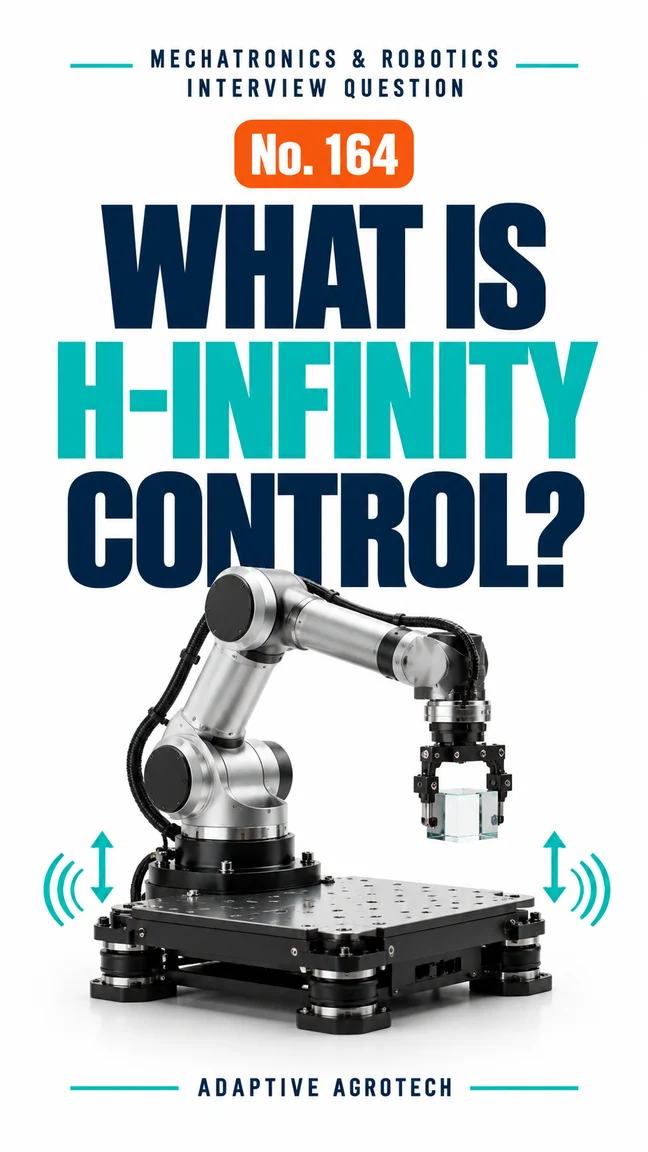
What Is H-Infinity Control?
H infinity control limits the worst case amplification from disturbances to selected outputs. For a stable linear system, its H infinity norm measures the largest gain across frequency and input directions.
The key idea
H infinity control limits the worst case amplification from disturbances to selected outputs. For a stable linear system, its H infinity norm measures the largest gain across frequency and input directions.
For a robot joint, disturbances can include load torque, while regulated outputs include tracking error and control effort. Frequency dependent weights express where accuracy matters and where large commands or sensor noise should be discouraged.
The objective concerns the chosen model and performance channels. It does not make every disturbance harmless. Check closed loop stability, uncertainty assumptions, actuator limits, and the effect of weights before claiming robust behavior on hardware.
What to remember
- Bound the largest modeled input–output gain
- Weights define what good performance means
- The bound applies to the modeled channels
Check your understanding
What does an H-infinity performance bound actually cover?
Show the explanation
It covers the worst-case input-output amplification for the modeled disturbance and regulated-output channels. Weights, uncertainty assumptions, actuator limits and closed-loop stability still need validation.