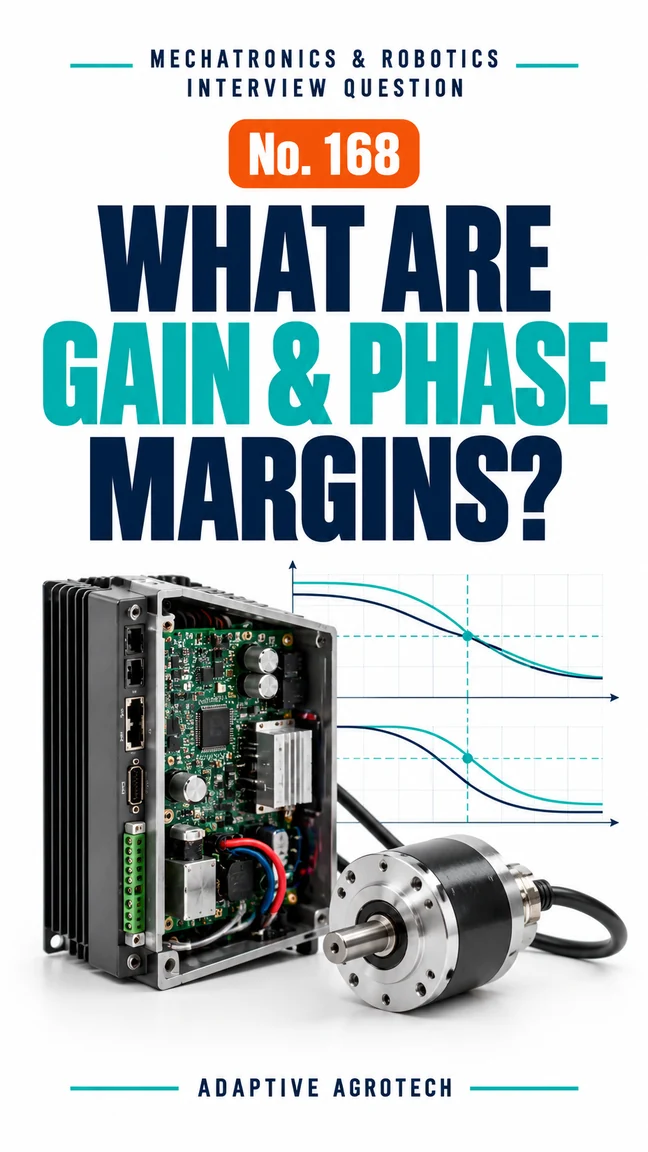
What Are Gain Margin and Phase Margin?
Gain and phase margins describe how a loop can change before reaching a stability boundary. For standard negative feedback, phase margin is measured at unity loop gain. Gain margin uses the minus one hundred eighty degree phase crossover.
The key idea
Gain and phase margins describe how a loop can change before reaching a stability boundary. For standard negative feedback, phase margin is measured at unity loop gain. Gain margin uses the minus one hundred eighty degree phase crossover.
On a robot servo's Bode plot, find zero decibel crossover and measure the remaining phase to minus one hundred eighty degrees. At phase crossover, measure the gain change needed to reach zero decibels.
Small margins indicate fragile modeled stability. Multiple crossovers, unstable open loop dynamics, and interacting multivariable loops require careful interpretation. Verify the closed loop and include sampling, computation, and communication delays in the analysis.
What to remember
- Margins describe modeled sensitivity to loop changes
- Phase and gain margins use different crossovers
- Margins need the correct stability context
Check your understanding
At which crossover is phase margin measured?
Show the explanation
Phase margin is measured at a unity-gain loop crossover. Gain margin uses a phase crossover at minus 180 degrees; multiple crossovers and unstable open-loop dynamics require careful interpretation.