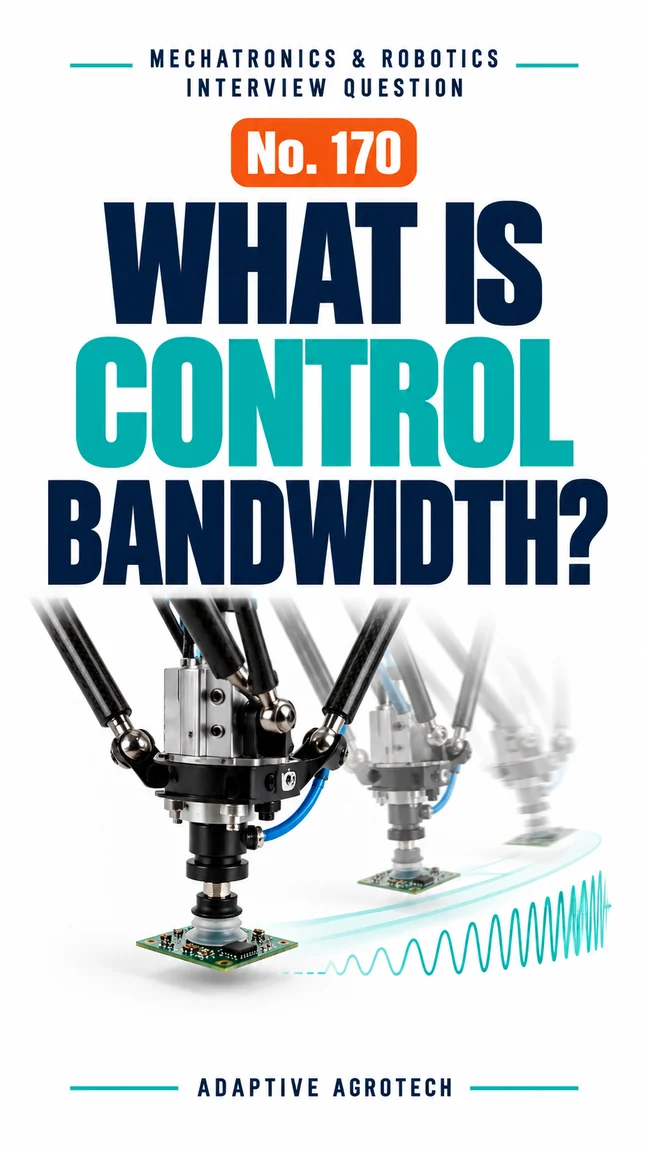
What Is Control Bandwidth?
Control bandwidth describes the frequency range over which a closed loop responds effectively. For a common low pass tracking response, bandwidth is the first frequency where magnitude falls three decibels below its low frequency value.
The key idea
Control bandwidth describes the frequency range over which a closed loop responds effectively. For a common low pass tracking response, bandwidth is the first frequency where magnitude falls three decibels below its low frequency value.
A robot joint can follow a slowly changing reference closely. As command frequency rises, tracking magnitude falls and phase lag grows. Wider bandwidth generally allows faster response, within available dynamics and control effort.
The controller can update many times within one motion cycle. Raising its software rate does not automatically widen mechanical bandwidth. Noise, resonance, delays, torque limits, and stability margins constrain how aggressively the loop can respond.
What to remember
- A common tracking definition uses the −3 dB point
- Commands near bandwidth become harder to track
- Update rate and bandwidth are different
Check your understanding
Does increasing the software update rate automatically increase control bandwidth?
Show the explanation
No. Mechanical dynamics, resonance, noise, delay, torque limits and stability margins constrain bandwidth. A higher update rate alone does not remove those limitations.