How Does Sampling Rate Affect a Digital Controller?
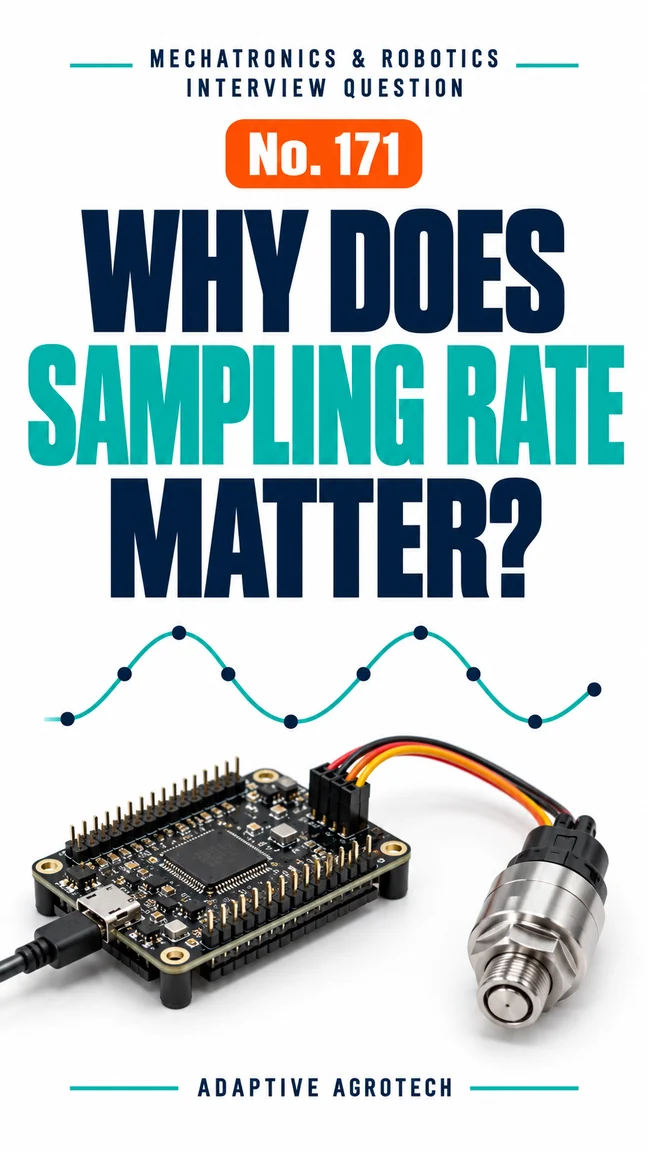
A digital controller observes and updates at discrete times. Sampling rate sets how often it can react. Between updates, the robot continues moving, and the actuator can hold the latest command.
The key idea
A digital controller observes and updates at discrete times. Sampling rate sets how often it can react. Between updates, the robot continues moving, and the actuator can hold the latest command.
For a robot following an oscillating reference, sparse samples can hide motion and introduce aliasing. Sampling and computation also add phase lag. A rate adequate for recording a signal can still be inadequate for feedback performance.
Choose the rate from robot dynamics, desired bandwidth, filtering, and total delay. No universal ratio guarantees success. Analyze the discrete controller and measure actual timing under realistic processor and communication load.
What to remember
- The robot keeps moving between samples
- Feedback needs more than the Nyquist limit
- Validate discrete dynamics and worst case timing
Check your understanding
Why is exceeding the Nyquist limit insufficient for feedback design?
Show the explanation
Feedback also depends on phase lag, desired bandwidth, filtering and total computation-to-actuation delay. Analyze the discrete controller and measure actual timing under realistic load.