What Is a Zero-Order Hold?
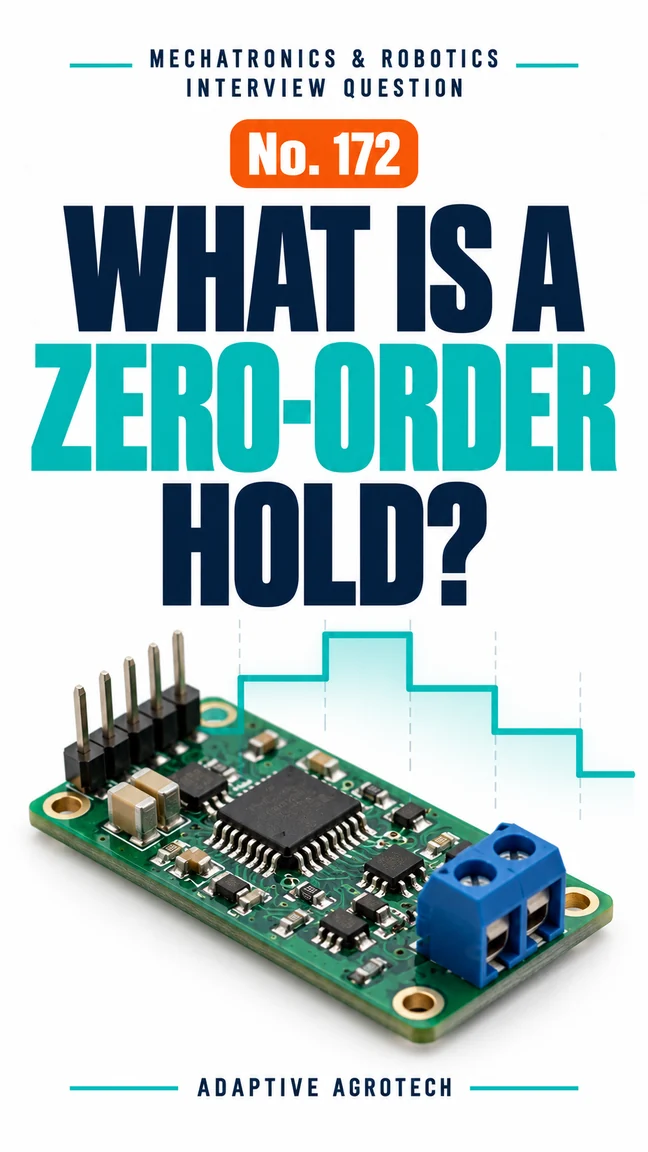
A zero order hold keeps each sampled command constant until the next update. Its output is a staircase. It does not draw a straight line between samples or predict the next command.
The key idea
A zero order hold keeps each sampled command constant until the next update. Its output is a staircase. It does not draw a straight line between samples or predict the next command.
A robot controller can calculate a new torque request every millisecond. The drive uses the latest request during that interval. A hold model captures the piecewise constant connection between digital commands and continuous physical motion.
Holding a signal changes its frequency response and introduces phase lag. Use a suitable sampled data model for controller design. A zero order hold and a one sample computational delay describe different effects and should not be confused.
What to remember
- Each sample stays constant for one interval
- A held command connects discrete control to motion
- A hold differs from a full sample delay
Check your understanding
How does a zero-order hold differ from a one-sample computational delay?
Show the explanation
The hold maintains the latest command between updates. A full-sample computational delay postpones when a new command becomes available; these are different effects in a sampled-data model.