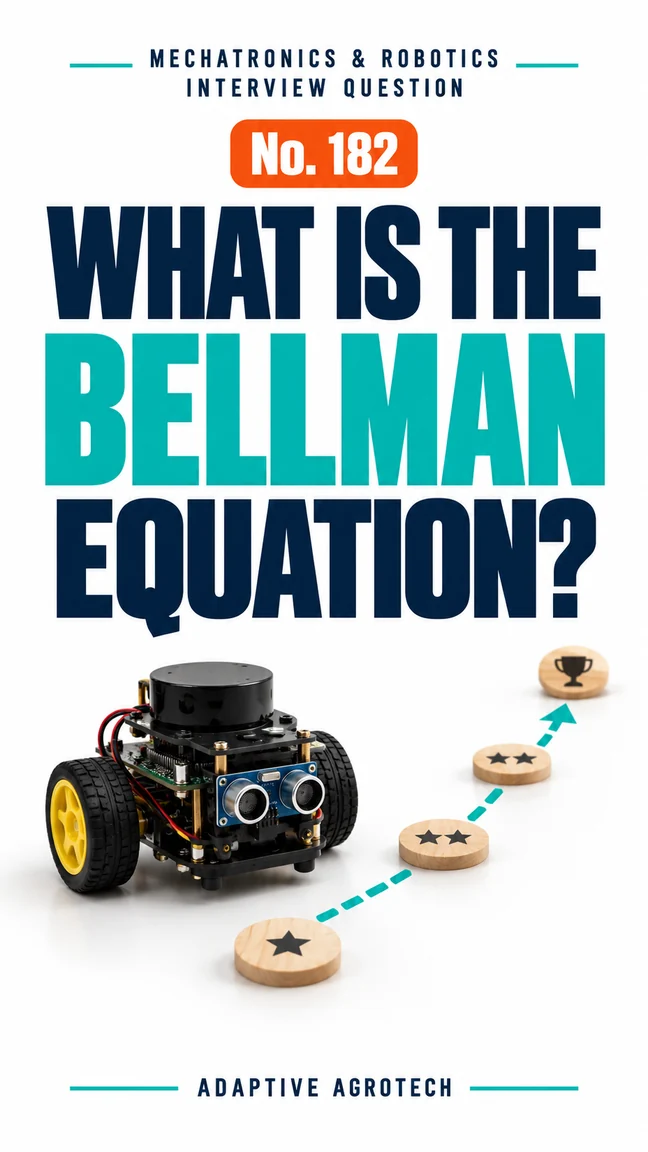
What Is the Bellman Equation?
The Bellman expectation equation relates a state’s value to expected immediate reward plus discounted next state value. The expectation averages actions from the policy and transitions from the environment.
The key idea
The Bellman expectation equation relates a state’s value to expected immediate reward plus discounted next state value. The expectation averages actions from the policy and transitions from the environment.
Suppose a robot receives reward two and moves to a state valued at five. With discount zero point nine, its one step target is two plus zero point nine times five, or six point five.
This target evaluates the specified policy. The Bellman optimality equation instead selects the best available action. At a terminal state, no future return remains. Approximate learned values can still contain substantial prediction error.
What to remember
- Current value includes reward and future value
- 2 + 0.9 × 5 = 6.5
- Evaluation and optimality are different equations
Check your understanding
What is the one-step target for reward 2, next value 5 and discount 0.9?
Show the explanation
The target is 2 + 0.9 × 5 = 6.5. This evaluates the specified policy; an optimality equation instead includes selecting the best available action.