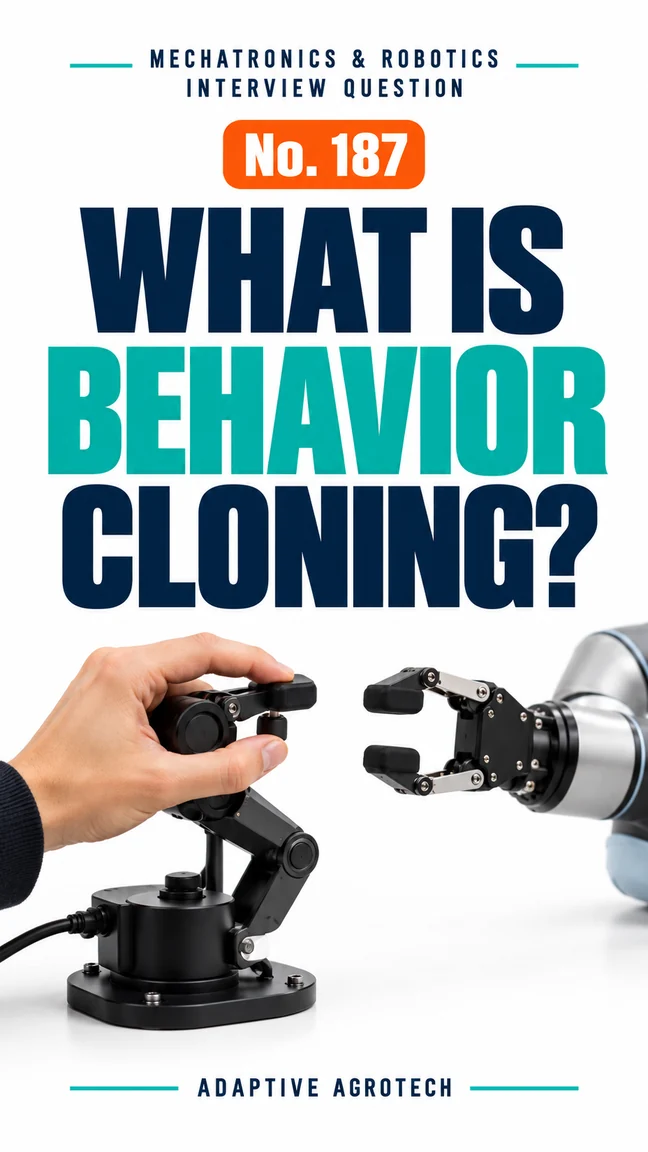
What Is Behavior Cloning?
Behavior cloning trains a policy to reproduce expert actions from paired observations and commands. It uses supervised learning, such as minimizing prediction error for continuous actions recorded while a person operates the robot.
The key idea
Behavior cloning trains a policy to reproduce expert actions from paired observations and commands. It uses supervised learning, such as minimizing prediction error for continuous actions recorded while a person operates the robot.
For a small vehicle, record lateral position and the expert’s steering correction. Fit a mapping from position error to steering. At deployment, the policy predicts a command from the current measured observation.
A small mistake can move the robot into states absent from the demonstrations. Predictions may then worsen and errors accumulate. Test recovery states and varied conditions. Low training error alone does not establish reliable closed loop behavior.
What to remember
- Learn the observation to action mapping
- Demonstrated corrections become training pairs
- Training accuracy does not prove recovery ability
Check your understanding
Why does low behavior-cloning training error not prove reliable robot control?
Show the explanation
Small control errors can lead into states missing from demonstrations, where prediction errors accumulate. Closed-loop recovery and varied operating conditions require separate evaluation.