What Is Inverse Reinforcement Learning?
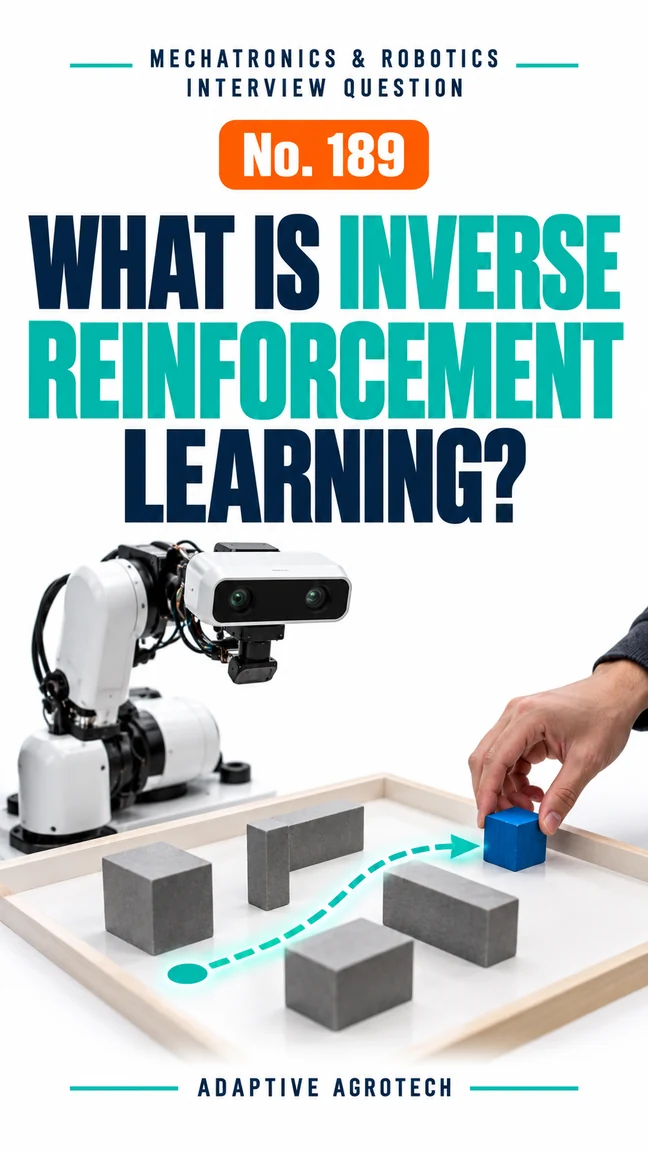
Inverse reinforcement learning infers a reward model that can explain demonstrated behavior. Ordinary reinforcement learning starts with a reward and seeks a policy. The inverse problem starts with behavior and reasons about its objective.
The key idea
Inverse reinforcement learning infers a reward model that can explain demonstrated behavior. Ordinary reinforcement learning starts with a reward and seeks a policy. The inverse problem starts with behavior and reasons about its objective.
Repeated robot routes might suggest a preference for shorter travel and greater obstacle clearance. A learned reward can combine these features, after which a planner or learning algorithm finds behavior that scores well.
Many reward functions can explain the same demonstrations. Results therefore depend on assumptions about the expert, reward representation, and available data. A fitted reward does not reveal a demonstrator’s true intention with certainty.
What to remember
- Demonstrations provide evidence about a reward
- Infer feature preferences, then optimize behavior
- Behavior does not identify one unique reward
Check your understanding
Can demonstrations identify the expert's true reward uniquely?
Show the explanation
Generally no. Several reward functions can explain the same behavior, so inference depends on the assumed expert model, reward representation and available demonstrations.