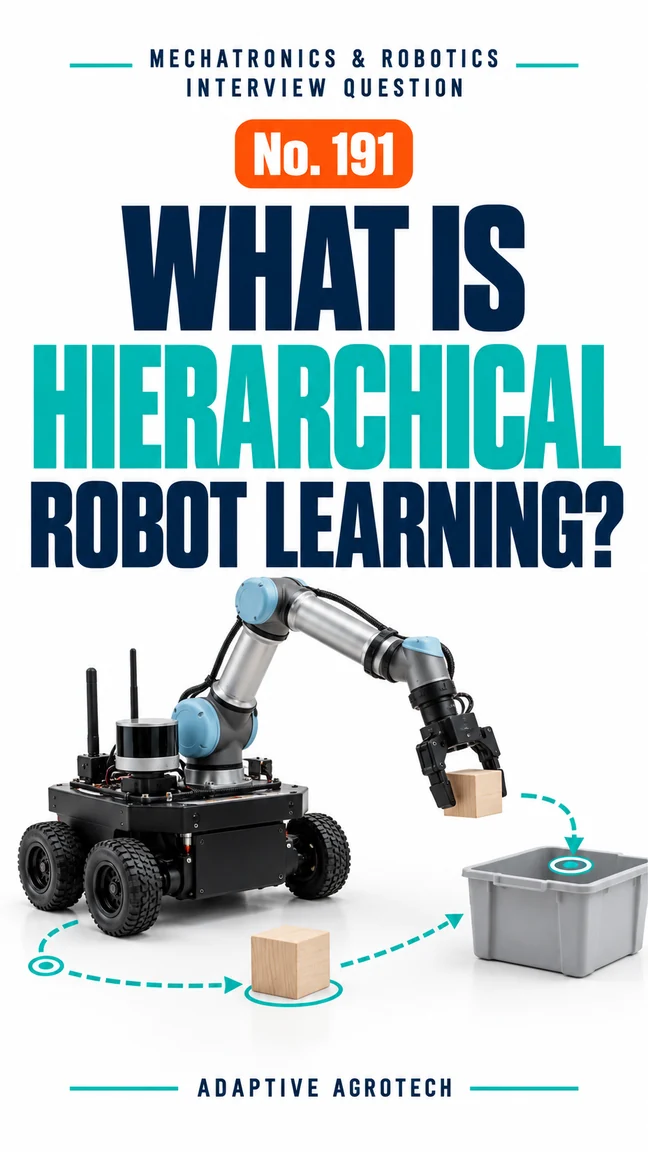
What Is Hierarchical Reinforcement Learning?
Hierarchical reinforcement learning organizes decisions across different time scales. A higher level policy selects a skill or subgoal. A lower level policy produces actions that carry out that choice over several time steps.
The key idea
Hierarchical reinforcement learning organizes decisions across different time scales. A higher level policy selects a skill or subgoal. A lower level policy produces actions that carry out that choice over several time steps.
A delivery task can use navigation, grasping, and placement skills. In the options framework, each skill has initiation conditions, an internal policy, and a termination rule. The manager decides which available option to invoke.
Skills must accept compatible observations and produce useful outcomes for the manager. Failure handling and termination conditions need attention. Decomposing a task can simplify learning, but a poorly chosen hierarchy can also restrict the solution.
What to remember
- A manager selects skills. Skills produce actions
- An option includes a policy and termination rule
- Useful skills need clear interfaces
Check your understanding
What defines an option in hierarchical reinforcement learning?
Show the explanation
An option includes initiation conditions, an internal policy and a termination rule. A higher-level manager selects among available options, so their interfaces and failure behavior matter.