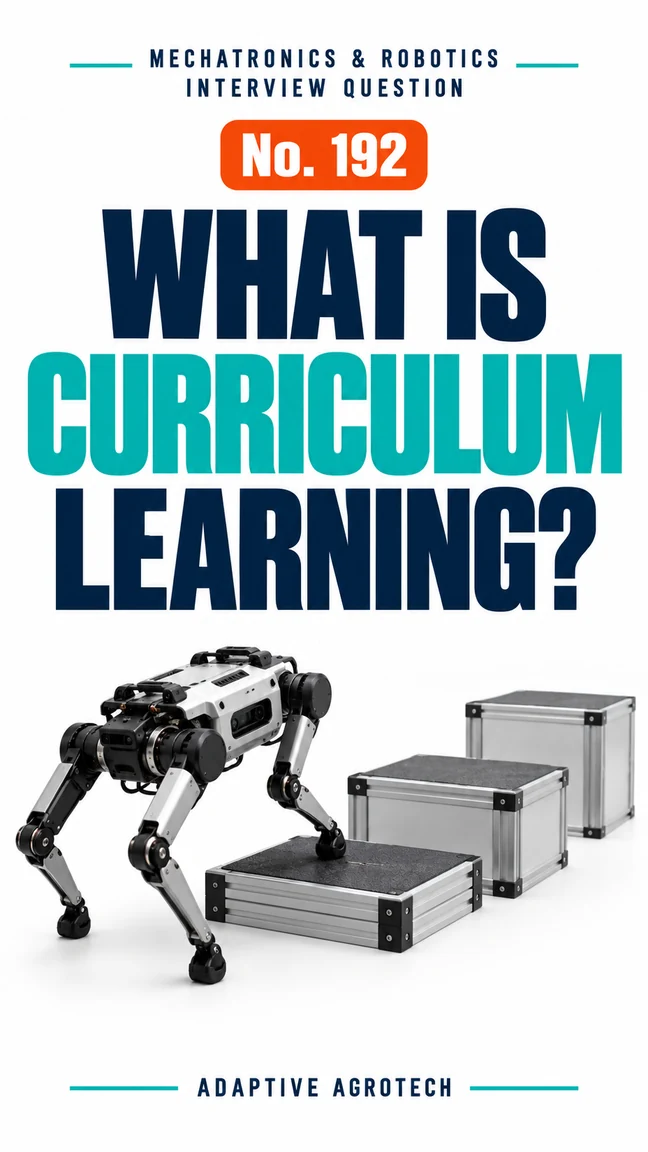
What Is Curriculum Learning in Robotics?
Curriculum learning changes the training tasks or their difficulty as learning progresses. A robot can first solve accessible cases, then encounter harder conditions once its current policy produces useful behavior more consistently.
The key idea
Curriculum learning changes the training tasks or their difficulty as learning progresses. A robot can first solve accessible cases, then encounter harder conditions once its current policy produces useful behavior more consistently.
Begin a reaching task with the gripper near its target. Gradually sample starting positions farther away. Reverse curriculum methods can expand the set of start states from which the policy learns to reach the goal.
Advance too quickly and learning may fail. Stay with easy cases and the robot may never master the intended task. Evaluate on the final task distribution, including cases excluded from the current training stage.
What to remember
- A curriculum schedules the learning challenge
- Expand successful starts toward harder cases
- Easy training success is not final task success
Check your understanding
Why must a curriculum-trained robot be evaluated on the final task distribution?
Show the explanation
Success on easier training stages may not cover the intended deployment cases. Progression must lead toward the final task, with held-out evaluation of relevant conditions.