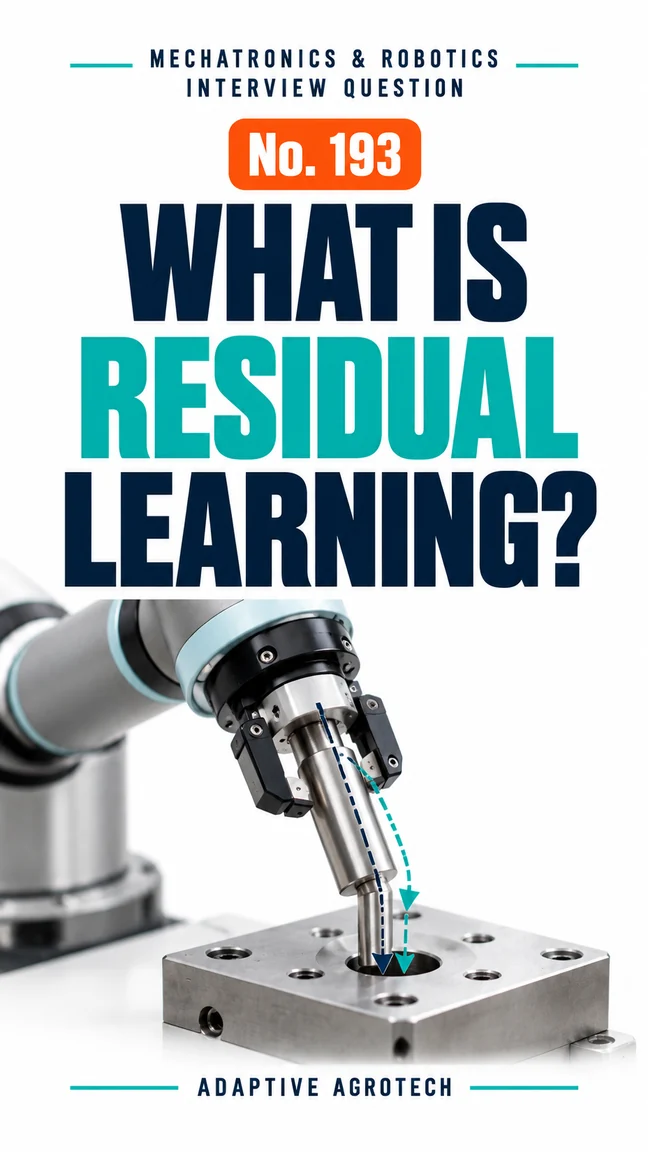
What Is Residual Learning for Robot Control?
Residual learning combines a conventional controller with a learned correction. The controller handles a known part of the task. A learned residual adjusts its command to address remaining errors or interactions that the model captures poorly.
The key idea
Residual learning combines a conventional controller with a learned correction. The controller handles a known part of the task. A learned residual adjusts its command to address remaining errors or interactions that the model captures poorly.
A baseline can move a peg toward a hole. A learned correction can adjust motion during contact when friction or alignment errors matter. Both command signals contribute to the final action sent to the robot.
Choose compatible command units and enforce actuator limits after combining signals. A stable baseline does not automatically make the learned combination stable. Bound and evaluate the residual under the contact and disturbance conditions that matter.
What to remember
- Command = baseline + learned residual
- The learned component corrects the baseline action
- A baseline’s guarantee may not survive addition
Check your understanding
Does a stable baseline controller guarantee stability after adding a learned residual?
Show the explanation
No. The added signal changes the combined system. Match command units, impose final actuator limits, bound the residual and evaluate the complete closed-loop behavior.