What Is the Sim-to-Real Gap?
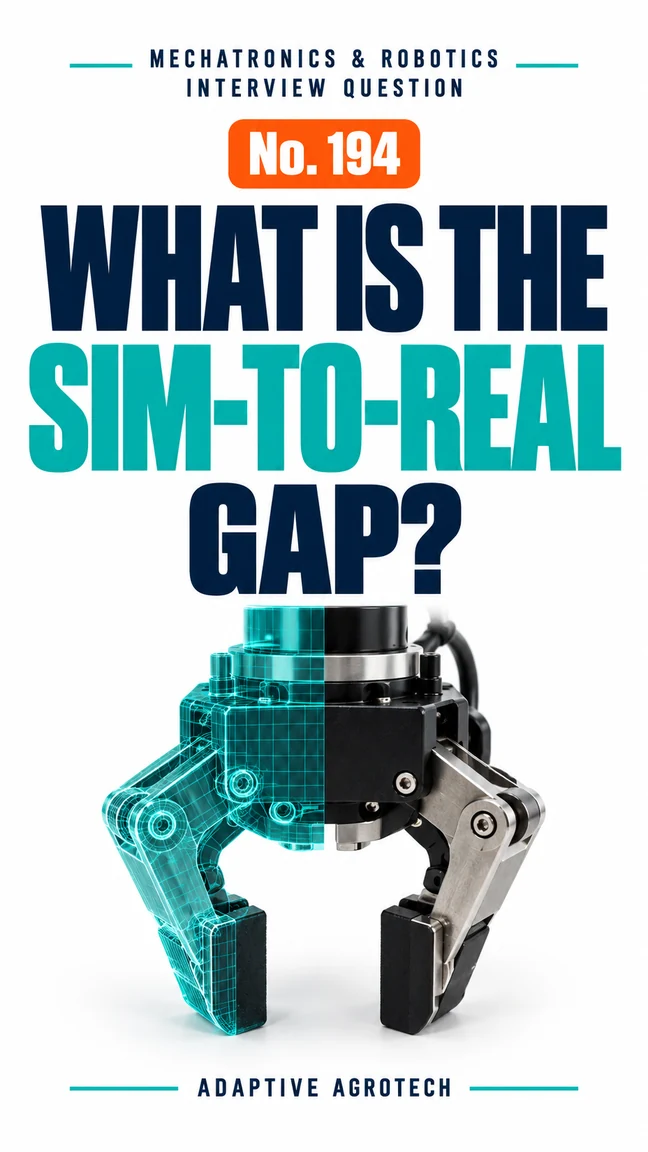
The sim to real gap is the mismatch between simulated training conditions and the physical robot. Differences in contact, friction, sensing, actuator response, and timing can change the consequences of the very same command.
The key idea
The sim to real gap is the mismatch between simulated training conditions and the physical robot. Differences in contact, friction, sensing, actuator response, and timing can change the consequences of the very same command.
A simulated controller may receive perfect observations immediately. On hardware, sensing and computation introduce delay. Even an otherwise similar model can then respond late, overshoot, or use measurements that no longer represent the current state.
Improve the model using measurements and test sensitivity to uncertain parameters. Randomized training can improve robustness across modeled variations. Validate on hardware incrementally because simulator success does not establish performance under unmodeled physical conditions.
What to remember
- The same command can produce different motion
- Include timing as well as physical parameters
- Simulation success requires physical validation
Check your understanding
Why can a successful simulated controller fail on an otherwise similar physical robot?
Show the explanation
Contact, friction, sensing, actuator behavior and timing can differ. Measurement delay alone can change the response; transfer needs incremental hardware validation under relevant uncertainties.