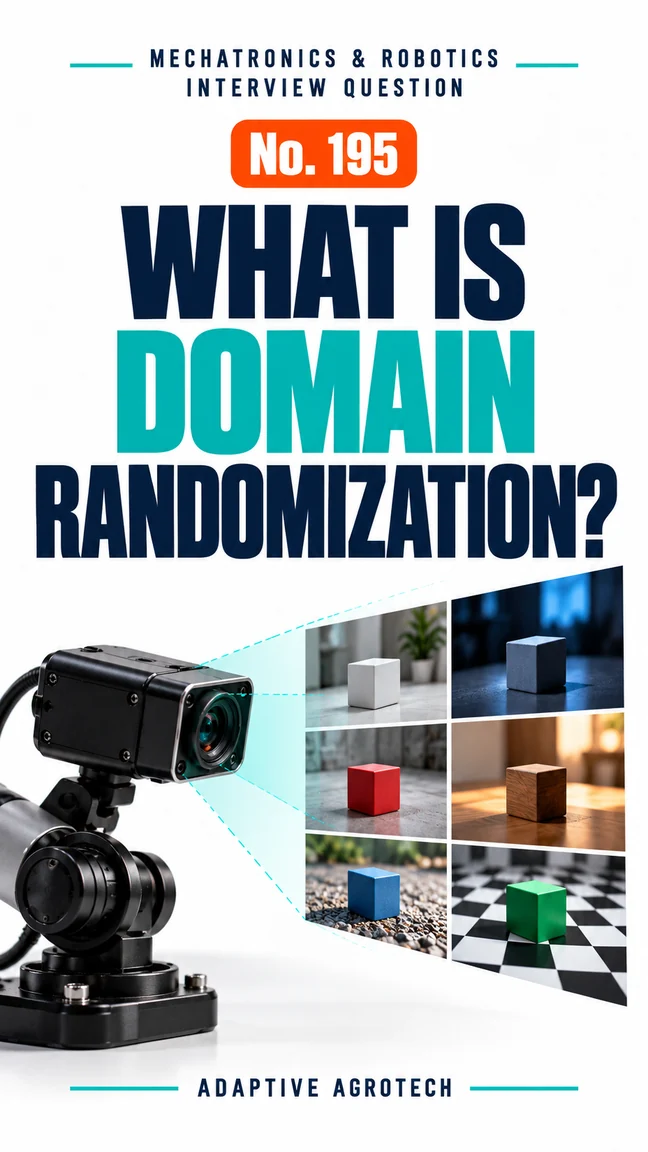
What Is Domain Randomization?
Domain randomization varies selected simulation conditions during training. Instead of learning from one exact world, a robot policy or perception model encounters a distribution of appearances or dynamics intended to encourage more robust behavior.
The key idea
Domain randomization varies selected simulation conditions during training. Instead of learning from one exact world, a robot policy or perception model encounters a distribution of appearances or dynamics intended to encourage more robust behavior.
A vision system can encounter different lighting and textures. A motion policy can encounter varied masses, friction, and delays. Choose variations that represent plausible uncertainty in the robot’s deployment environment and observation process.
Very narrow ranges may miss real conditions. Unrealistic ranges can make training unnecessarily difficult. A policy can still fail outside the trained distribution. Keep separate test conditions and verify which variations the resulting model can actually handle.
What to remember
- Training samples a distribution of worlds
- Randomize the uncertainties relevant to the task
- Randomization provides coverage, not universal robustness
Check your understanding
Why do randomization ranges matter as much as choosing to randomize?
Show the explanation
Narrow ranges may miss real deployment conditions, while unrealistic ranges can make training unnecessarily hard. Randomization provides modeled coverage rather than universal robustness.