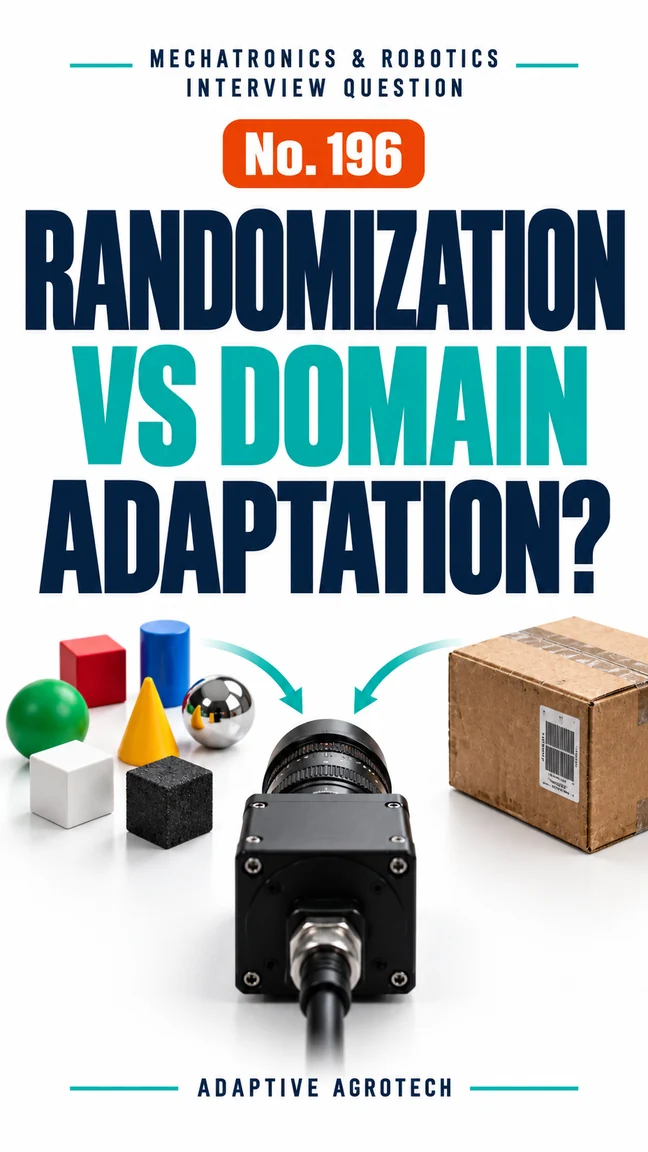
What Is the Difference Between Domain Randomization and Domain Adaptation?
Domain randomization trains across varied simulated conditions. Domain adaptation uses information from a target domain to reduce mismatch with a source domain. The methods address related problems, but they use training data in different ways.
The key idea
Domain randomization trains across varied simulated conditions. Domain adaptation uses information from a target domain to reduce mismatch with a source domain. The methods address related problems, but they use training data in different ways.
Randomization can generate many simulated views of an object. Adaptation can then use real camera observations to align representations or fine tune the model. Some methods need labels, while others use unlabeled target examples.
Randomization and adaptation can work together. Adaptation must avoid overfitting to a small target sample. Evaluate on separate real observations and actual task performance. Reducing a feature mismatch alone does not prove that the robot’s actions are reliable.
What to remember
- Randomization varies source worlds. Adaptation uses target data
- Target observations can guide an adapted representation
- Evaluate the adapted model beyond its target sample
Check your understanding
How does domain adaptation differ from domain randomization?
Show the explanation
Randomization varies source simulation conditions. Adaptation uses target-domain information to reduce mismatch, such as real camera observations used for representation alignment or fine-tuning.