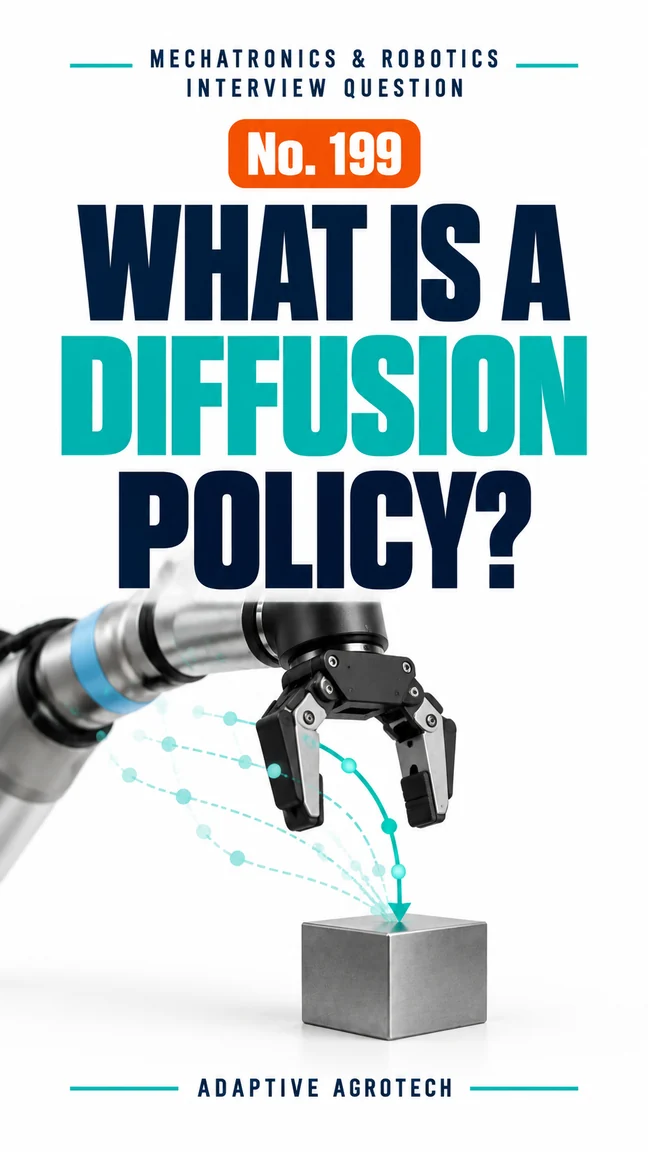
What Is a Diffusion Policy?
A diffusion policy learns to generate robot action sequences by gradually removing noise. During inference, observations condition this process, so an initially noisy sequence becomes a candidate movement consistent with the learned demonstrations.
The key idea
A diffusion policy learns to generate robot action sequences by gradually removing noise. During inference, observations condition this process, so an initially noisy sequence becomes a candidate movement consistent with the learned demonstrations.
For a gripper moving around an obstacle, demonstrations may contain different valid approaches. The policy can represent these alternatives. It predicts a sequence, executes a portion, then observes again before choosing the next movement.
The denoising steps take computation, and the generated action is not a proof of collision avoidance. Evaluate inference time, feedback frequency, and behavior outside the demonstration data. The controller must still enforce the robot limits.
What to remember
- Denoising turns noise into candidate actions
- Observe again after executing a short prefix
- Generated actions still need timely feedback
Check your understanding
Why execute only a prefix of a generated diffusion-policy action sequence?
Show the explanation
Observing again permits correction before the entire predicted movement is committed. Denoising computation, feedback frequency and robot limits must fit the physical task.