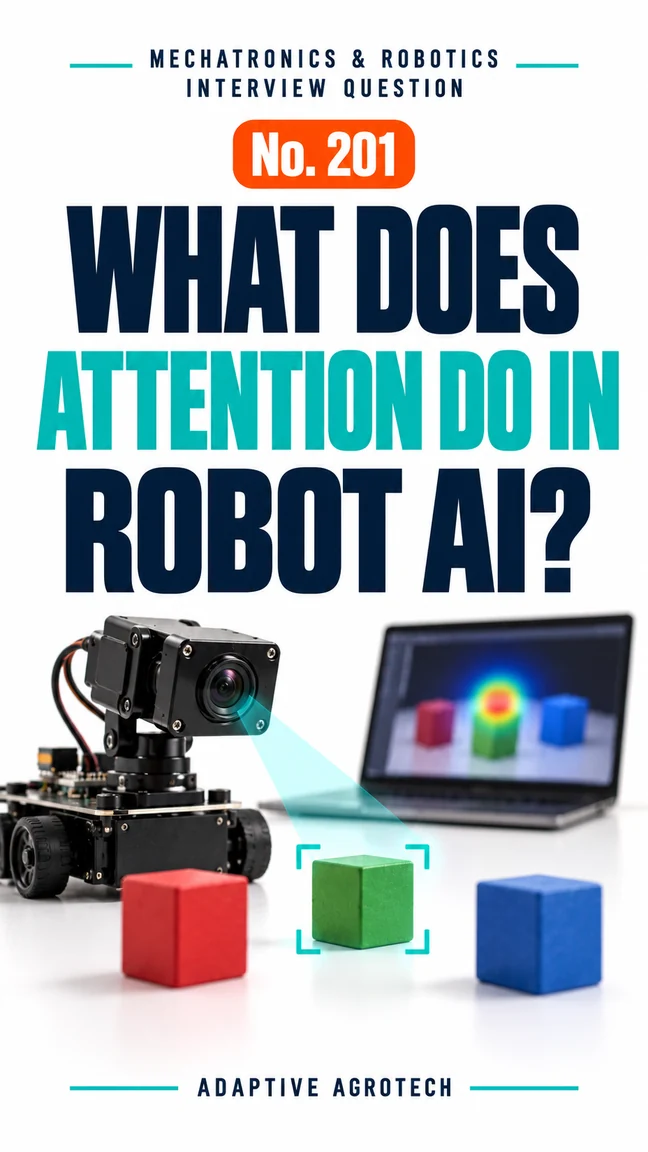
What Does Attention Do in a Robotics Transformer?
Attention lets a transformer combine information from different input tokens. A query compares with keys, the scores become normalized weights, and those weights combine values. This gives each output a context dependent mixture of information.
The key idea
Attention lets a transformer combine information from different input tokens. A query compares with keys, the scores become normalized weights, and those weights combine values. This gives each output a context dependent mixture of information.
In a robot policy, tokens may describe image patches, joint state, or an instruction. A gripper action can use information from the target object and the current arm position rather than treating every input equally.
Several attention heads can learn different relationships. Large attention weights show part of a computation, but they do not by themselves explain why the robot acted or prove the decision was correct in the physical scene.
What to remember
- Attention computes a weighted mixture of values
- Useful context can span images and robot state
- An attention map is not a safety explanation
Check your understanding
Does a large attention weight prove why a robot acted correctly?
Show the explanation
No. Attention weights describe part of a learned computation, but do not alone establish a causal explanation or physical correctness. Task-level evaluation is still needed.