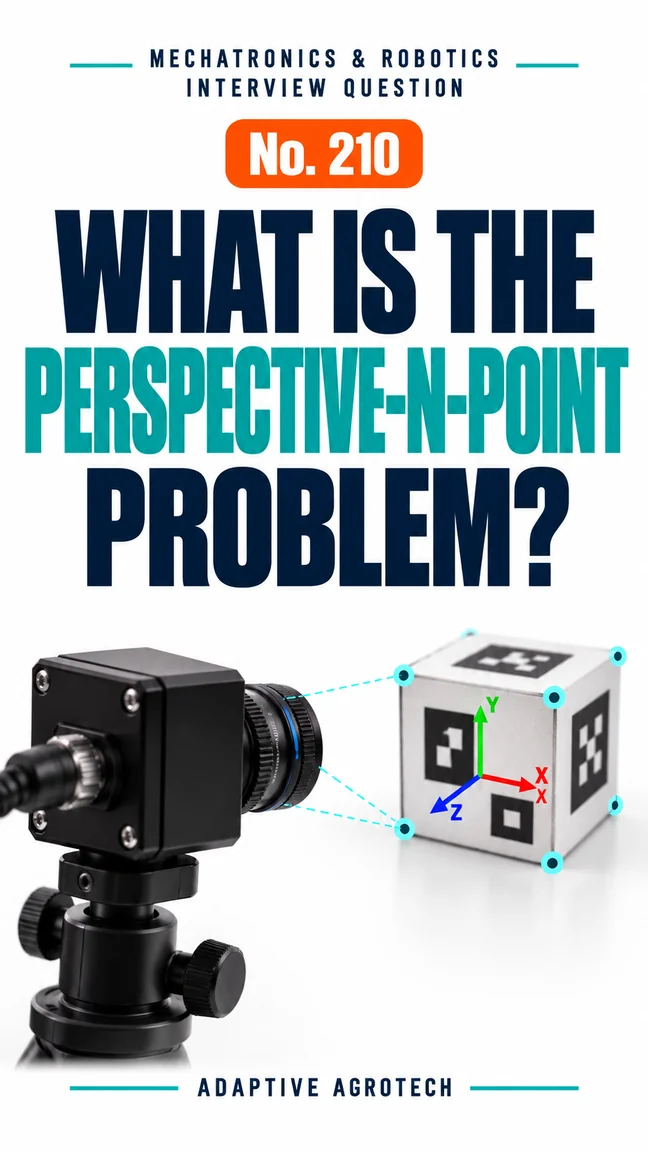
What Is the Perspective-n-Point Problem?
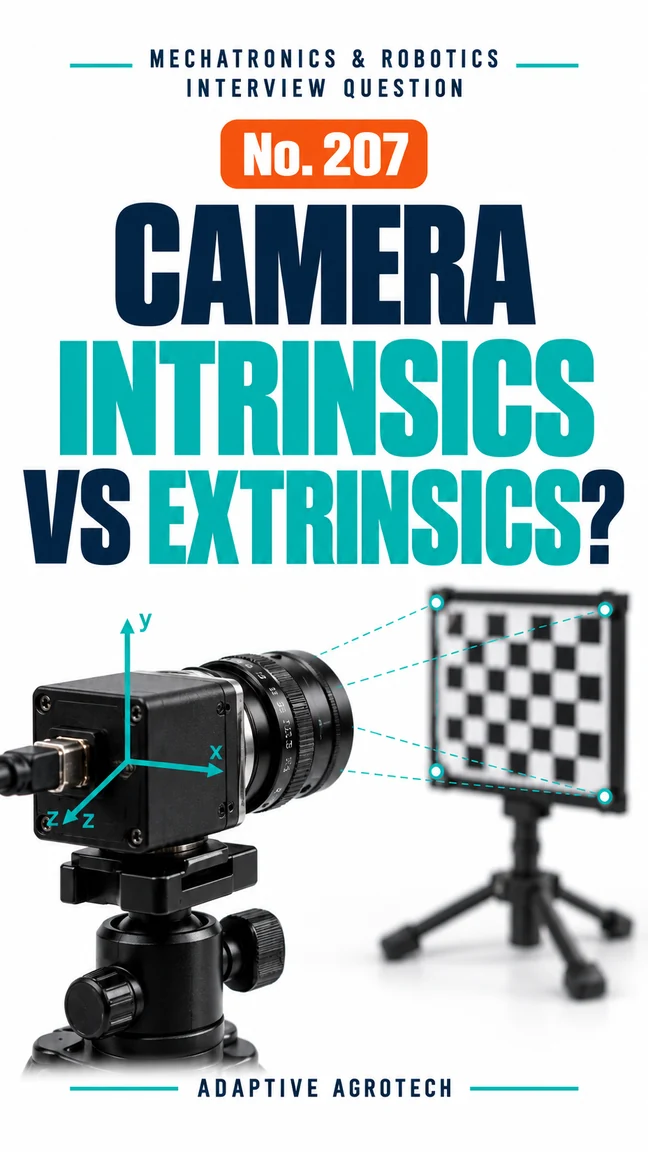
Perspective n point estimates a camera relative pose from known three dimensional points and their corresponding two dimensional image locations. The camera intrinsics are also inputs. The unknowns are the rotation and translation relating the coordinate frames.
The key idea
Perspective n point estimates a camera relative pose from known three dimensional points and their corresponding two dimensional image locations. The camera intrinsics are also inputs. The unknowns are the rotation and translation relating the coordinate frames.
A robot sees corners on a known fixture. Matching each corner to its known location lets a pose solver estimate the fixture relative to the camera. The resulting transform can support a grasp or a docking alignment.
Too few, poorly arranged, or incorrect correspondences can produce unreliable or ambiguous solutions. Requirements depend on the solver and point configuration. Check reprojection error, positive depth, and consistency with the robot workspace before using the estimate.
What to remember
- Known 3D to 2D correspondences constrain pose
- PnP estimates pose using known geometry
- Pose quality depends on correspondences and geometry
Check your understanding
What information does a Perspective-n-Point solver need?
Show the explanation
Known 3D points, their corresponding 2D image locations and camera intrinsics constrain relative pose. Correspondence quality, point arrangement and solver assumptions determine reliability.