What Is the Difference Between Semantic and Instance Segmentation?
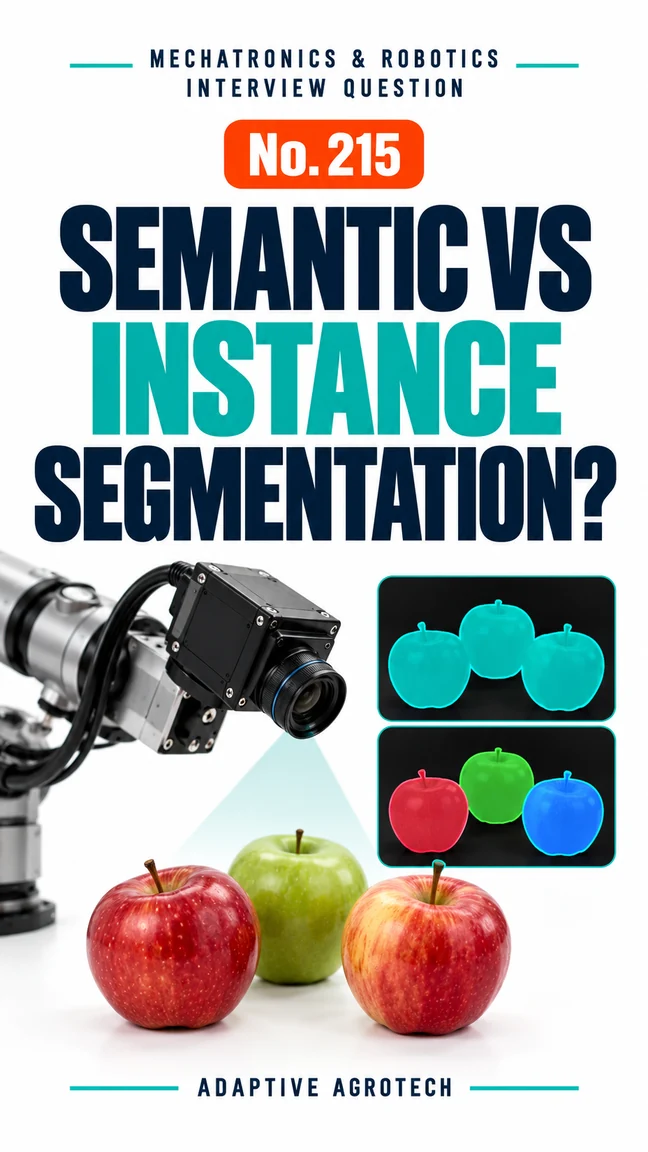
Semantic segmentation assigns a class label to each image pixel. Instance segmentation also distinguishes separate objects of the same class. Two cups can share the semantic label cup while receiving different instance identities in the same image.
The key idea
Semantic segmentation assigns a class label to each image pixel. Instance segmentation also distinguishes separate objects of the same class. Two cups can share the semantic label cup while receiving different instance identities in the same image.
For a picking robot, a semantic mask identifies cup pixels. Instance masks separate the left cup from the right cup, helping select an individual target. Neither mask alone supplies the complete three dimensional grasp geometry.
Touching objects, occlusion, and small structures make separation difficult. A merged mask can lead to a poor grasp target. Check instance quality, depth, and pose estimates together before converting a mask into a physical action.
What to remember
- Semantic masks label classes; instance masks separate objects
- Picking one cup requires an individual target
- A useful mask still needs geometry for action
Check your understanding
Why is semantic segmentation alone insufficient to select one of two touching cups?
Show the explanation
It labels their pixels with the same class. Instance segmentation separates individual objects, after which reliable picking still needs depth and pose geometry.