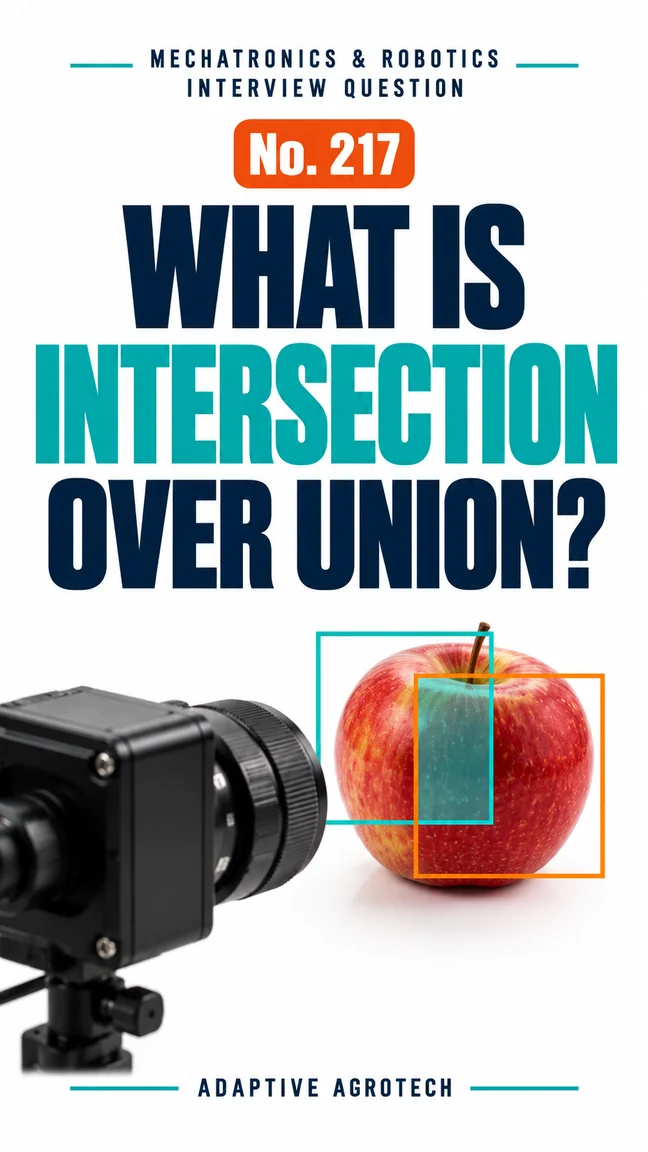
What Is Intersection over Union in Object Detection?
Intersection over union compares two regions by dividing their overlapping area by their union area. In object detection, it often compares a predicted box with a labeled reference box. Identical boxes score one, and disjoint boxes score zero.
The key idea
Intersection over union compares two regions by dividing their overlapping area by their union area. In object detection, it often compares a predicted box with a labeled reference box. Identical boxes score one, and disjoint boxes score zero.
Two boxes each cover one hundred square units, and their intersection covers fifty. Their union covers one hundred fifty, because the overlap counts only once. The intersection over union is therefore one third, rather than one half.
A detection benchmark chooses rules for matching predictions to objects. IoU measures geometric overlap but says nothing directly about class correctness or grasp safety. Small shifts can greatly affect tiny boxes, so inspect the relevant object sizes.
What to remember
- IoU = intersection area / union area
- Union = area A + area B - intersection
- Overlap quality and task success are different measures
Check your understanding
Two boxes have area 100 each and intersection 50. What is their IoU?
Show the explanation
Their union is 100 + 100 − 50 = 150, so IoU is 50/150 = one third. Overlap alone does not assess class correctness or grasp safety.