What Is the Difference Between Proprioception and Exteroception?
Proprioception measures the robot's own state, such as joint angle, wheel motion, or body acceleration. Exteroception measures the surrounding environment, such as scene images or ranges to obstacles. The distinction concerns what the measurement describes.
The key idea
Proprioception measures the robot's own state, such as joint angle, wheel motion, or body acceleration. Exteroception measures the surrounding environment, such as scene images or ranges to obstacles. The distinction concerns what the measurement describes.
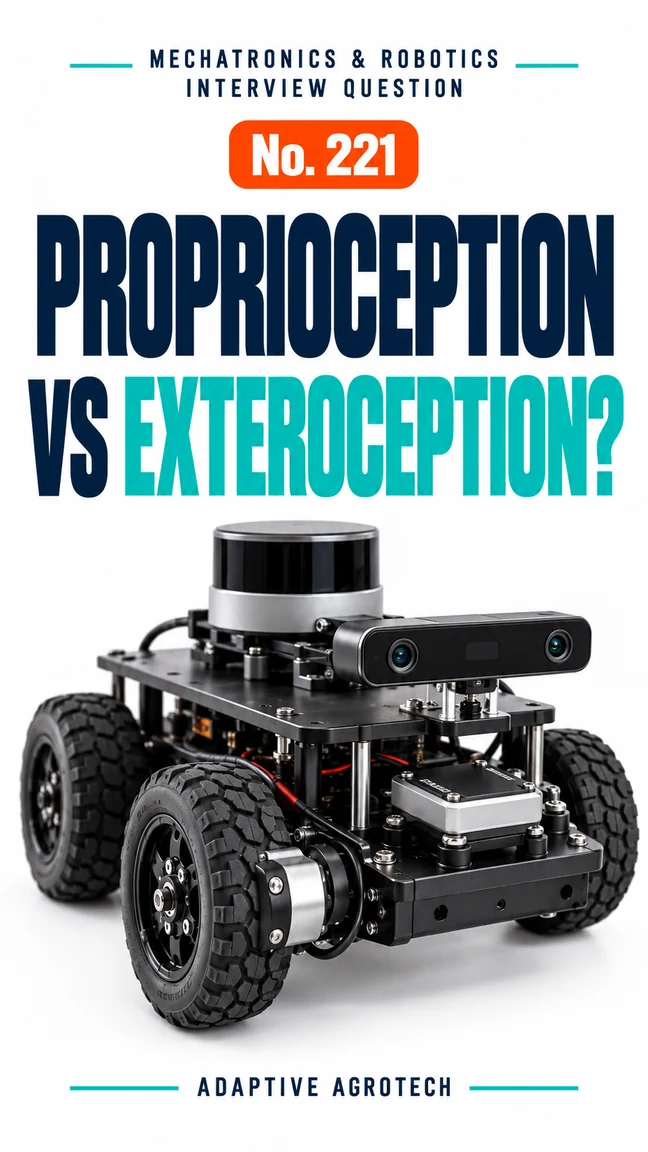
A mobile robot encoder reports wheel rotation, while a camera observes a wall. The wheel measurement helps predict motion, but slip can break the rolling assumption. External scene measurements can provide additional evidence about movement relative to the world.
Sensors can serve more than one purpose, and neither category is automatically accurate. Consider noise, timing, calibration, and observability. A useful robot estimate comes from measurements that constrain the variables required by its task.
What to remember
- Internal state and external scene answer different questions
- A wheel reading alone does not establish world motion
- Measurement meaning matters more than the sensor label
Check your understanding
Why does a wheel encoder alone not prove how far a robot moved through the world?
Show the explanation
It measures wheel rotation, a robot-state quantity. Slip can violate rolling assumptions, so external scene observations can provide additional evidence of motion relative to the environment.