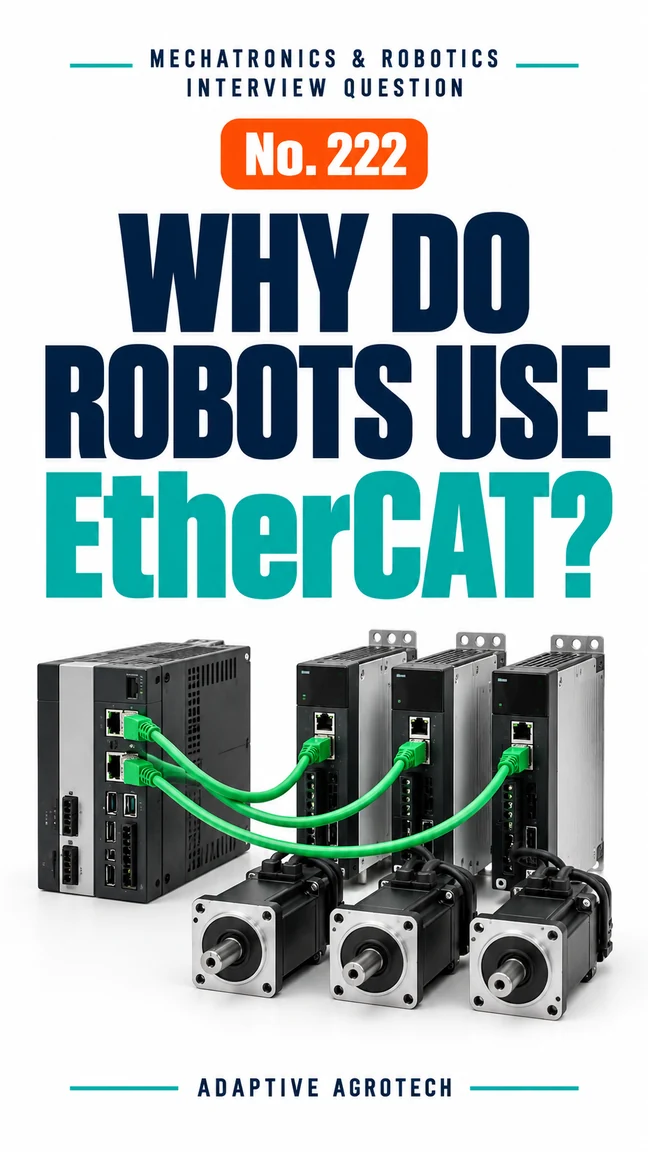
What Is EtherCAT, and Why Is It Used in Robotics?
EtherCAT is an industrial Ethernet technology for exchanging control data with drives and sensors. Each device reads or writes its assigned data while a frame passes through its communication hardware.
The key idea
EtherCAT is an industrial Ethernet technology for exchanging control data with drives and sensors. Each device reads or writes its assigned data while a frame passes through its communication hardware.
In a robot arm, the controller can send joint commands and collect feedback in a cyclic exchange. Distributed clocks let capable devices sample inputs or update outputs against a shared time reference.
This supports coordinated motion, but the network alone does not guarantee a control deadline. Check controller scheduling, device support, cable topology, and the complete sensor to actuator timing budget.
What to remember
- Devices process their assigned frame data
- Distributed clocks align local device timing
- A synchronized bus still needs a timed control system
Check your understanding
What do EtherCAT distributed clocks contribute to coordinated axes?
Show the explanation
They align capable devices to a shared time reference for sampling or outputs. Controller scheduling, hardware support and the full sensor-to-actuator timing budget still determine deadlines.