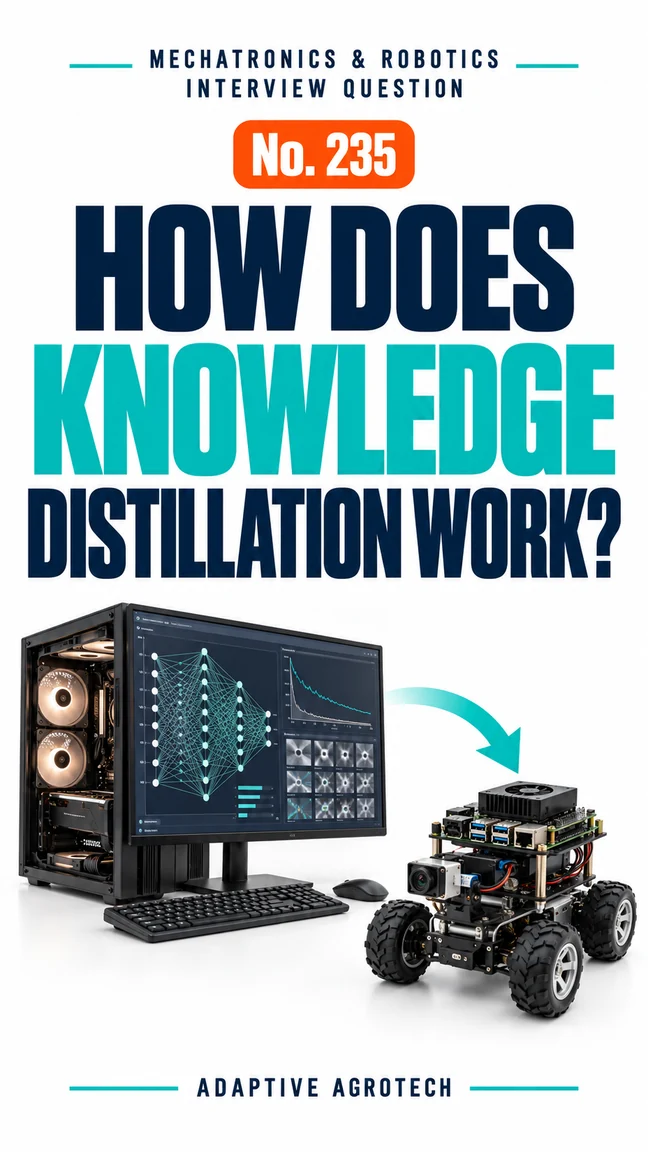
What Is Knowledge Distillation for Robot AI?
Knowledge distillation trains a smaller student model with guidance from a larger teacher. The student can learn from the teacher’s output distribution or internal representations, often alongside ordinary labeled training examples.
The key idea
Knowledge distillation trains a smaller student model with guidance from a larger teacher. The student can learn from the teacher’s output distribution or internal representations, often alongside ordinary labeled training examples.
For a robot vision example, the teacher assigns probabilities to several object classes. Those softer targets contain information beyond one winning label. A training loss encourages the student to reproduce useful structure in those predictions.
After training, the robot can run the student without carrying the teacher. Compression may reduce computation, but accuracy and robustness are not guaranteed. Evaluate the student on representative tasks and unfamiliar operating conditions.
What to remember
- The teacher supplies training guidance
- Soft targets convey relationships between predictions
- Deploy the student and measure retained capability
Check your understanding
Must the teacher model remain on the robot after distillation training?
Show the explanation
No. The trained student can perform inference independently. Evaluate retained accuracy, robustness and compute costs because a smaller model does not automatically preserve every teacher capability.