
Video by Adaptive AgroTech. If the embedded player is unavailable, open the original video ↗.
Continue exploring
All interview topics →Related topics

PID Control: Keeping Robot Speed on Target
PID speed control compares encoder feedback with a target and adjusts motor drive. Proportional, integral, and derivative actions address different error behavior, while output limits and anti-windup handle actuator saturation.
Watch & explore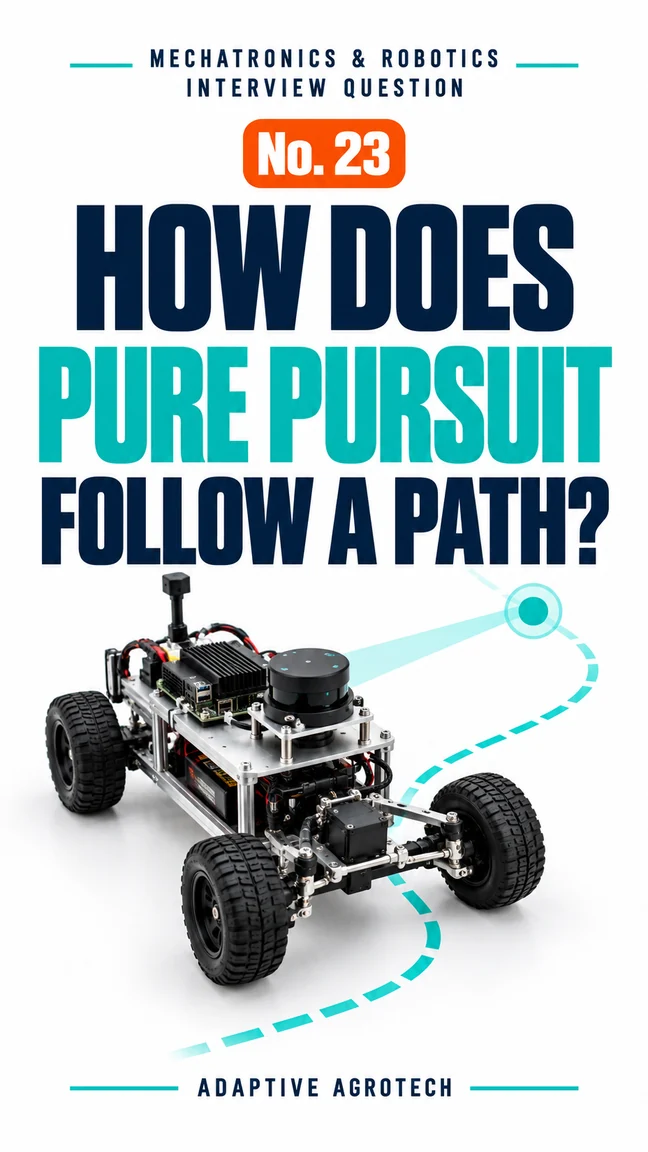
How Pure Pursuit Keeps a Robot on Its Path
Pure pursuit tracks a path by steering toward a moving look-ahead target. Target geometry sets curvature and yaw rate, while look-ahead trades responsiveness against smoothness and does not replace obstacle checking.
Watch & explore
How a Robot Finds and Docks at Its Charger
Automatic docking combines navigation, close-range pose sensing, slow alignment, and electrical confirmation. Successful motion alone is insufficient: charging feedback, timeouts, and bounded recovery attempts determine whether docking actually succeeded.
Watch & explore
Model Predictive Control: Predict Before You Steer
Model predictive control compares future command sequences over a finite horizon. It optimizes tracking and effort within modeled constraints, applies one command, and solves again, making model quality and computation deadlines essential.
Watch & explore