How an Arduino Controls an Industrial Hydraulic Valve
An Arduino can request motion from a hydraulic valve by sending an electrical command. The command, the coil drive and the hydraulic flow each play a different role.
Watch & exploreExplore one engineering idea at a time. Watch a short lesson, read the key concepts and test your understanding before your next interview, project or class.
Video · Key ideas · Check your understanding
An Arduino can request motion from a hydraulic valve by sending an electrical command. The command, the coil drive and the hydraulic flow each play a different role.
Watch & exploreAn industrial control panel has two paths worth tracing. One carries power to the load and the other carries measurements and commands.
Watch & exploreA bright lamp in a night image can wash out adjacent detail. Exposure saturation and reflections inside the optics leave different clues in the frame.
Watch & exploreSoil probes, tank-level strips and cup anemometers measure different physical effects. Interpreting their outputs requires knowing what changes the electrical reading.
Watch & exploreA MOSFET uses gate-to-source voltage to control current through a load. Its on-resistance at the available gate voltage matters when estimating heat.
Watch & exploreA buck-boost converter lets a 5 V fan run from an input that moves above or below 5 V. The source current changes even while the output voltage stays steady.
Watch & exploreA 24 V industrial sensor and a 3.3 V microcontroller have different electrical limits. The choice of input interface starts with the sensor’s output type.
Watch & exploreA solar weather station joins an energy supply, a digital environmental sensor and a directional wind sensor. Each path answers a different design question.
Watch & exploreAn Arduino Nano uses an MQ-2 reading to switch a fan through a relay. Separate switching thresholds keep small fluctuations from repeatedly cycling the fan.
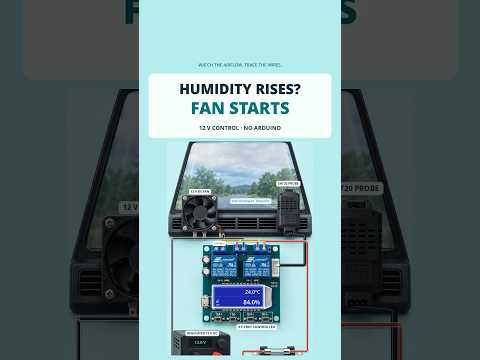
Watch & exploreA humidity controller starts a windshield fan at 80% relative humidity and stops it at 65%. Between those levels, the previous fan state matters.
Watch & exploreA 433 MHz radio link turns a button press into a message for a remote Arduino. A receiver timeout gives the LED a defined state when a release message is lost.
Watch & exploreAn ESP32 hosts a local Wi-Fi page that commands a servo to move a model gate. The phone supplies the command while a separate electrical path supplies the motor current.
Watch & exploreA robot that moves smoothly through free space can oscillate when its tool touches a stiff surface. In contact, a small displacement can produce a large change in force.
Watch & explorePNP and NPN describe how a sensor output completes its electrical circuit. Matching the output to the receiving input determines whether that input can detect the active state.
Watch & exploreA Raspberry Pi and a RAK2287 concentrator form a LoRaWAN gateway that forwards sensor uplinks to The Things Stack. The example follows an EU868 sensor packet across the radio and network connections.
Watch & exploreA water sensor under a sink detects a drip when conductive water bridges its exposed traces. An Arduino turns the resulting signal into a light and buzzer alert.
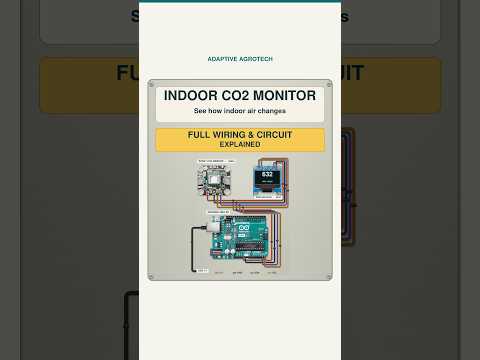
Watch & exploreAn SCD41 and an Arduino can track how indoor carbon dioxide changes after a window opens. A time series helps distinguish a trend from a single reading.
Watch & exploreAn accelerometer on a washer cabinet can detect motion and quiet periods. An Arduino uses the duration of a quiet period to infer when a cycle has probably ended.
Watch & exploreAn Arduino can request the engine-speed parameter through OBD-II over a compatible CAN connection. The returned data bytes encode RPM and need decoding before display.
Watch & exploreA balancing cart must control both pole angle and cart travel. The same disturbance lets you compare how a PID cascade and a linear quadratic regulator trade one goal against the other.
Watch & exploreA patrol robot can use a camera for person detection and ultrasound for range. The controller can request a stop when the distance measurement indicates a blocked path.
Watch & exploreAn Arduino waits until an object remains within 40 cm of the distance sensor for two seconds before sending an infrared PAUSE command. It sends one command per approach.
Watch & exploreTwo float switches give a tank filler separate start and stop levels. A 555 latch keeps the pump command steady as the level passes between them.
Watch & exploreA camera can classify visible tomato color as one indicator of maturity. The example assigns a red label with 92% confidence.
Watch & explore