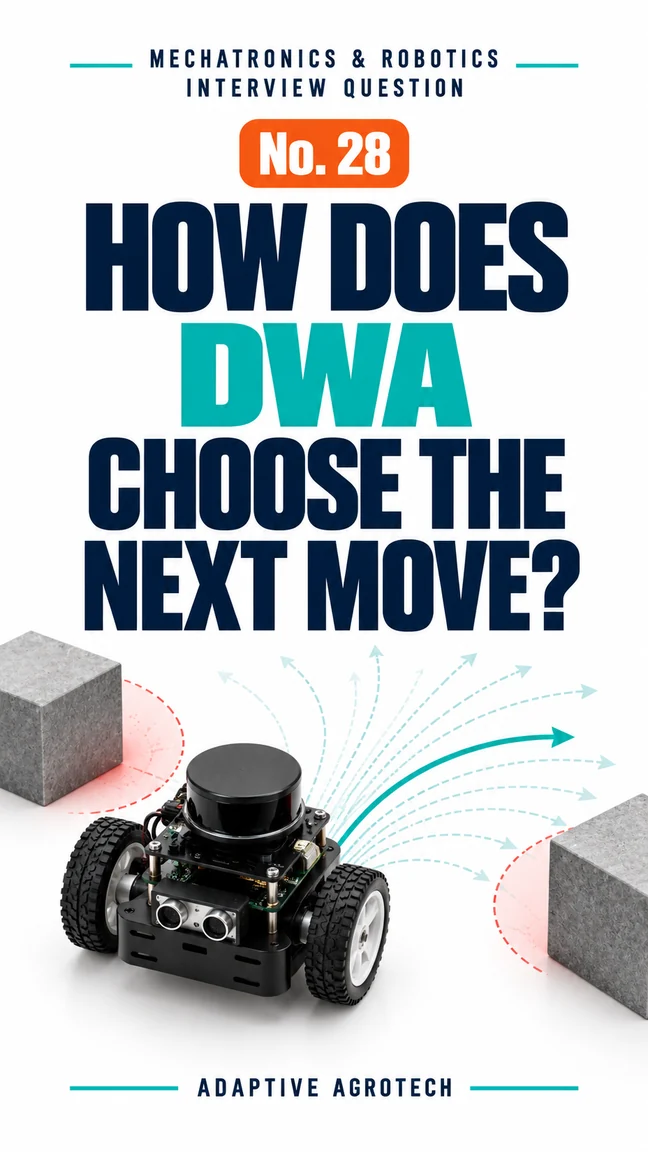
Dynamic Window Approach: How a Robot Chooses Its Next Move
The dynamic window approach chooses reachable forward and turning velocities by predicting short trajectories. Collision and braking checks filter candidates before scoring, and repeated execution depends on good sensing and a wider navigation strategy.
The key idea
DWA chooses a pair of forward and angular velocities rather than a direction alone. Acceleration limits and the control interval define a reachable window around current velocity. For each candidate, the planner predicts a short motion arc and checks the complete robot footprint. Candidates are rejected for collisions or insufficient stopping distance under the assumed braking limits. Remaining motions are scored for goal progress, clearance, and speed. The chosen command runs briefly before sensing and recomputation. Difficult layouts can cause hesitation or trapping, so sensing coverage, scoring weights, a global route, and a safe stop policy remain important.
What to remember
- Acceleration limits define reachable candidate velocities.
- Admissibility checks include robot footprint and stopping distance.
- The method executes briefly and recomputes from fresh observations.
Check your understanding
Why are candidate velocities restricted to a dynamic window?
Show the explanation
The robot's acceleration limits prevent it from reaching arbitrary speeds within one control interval.