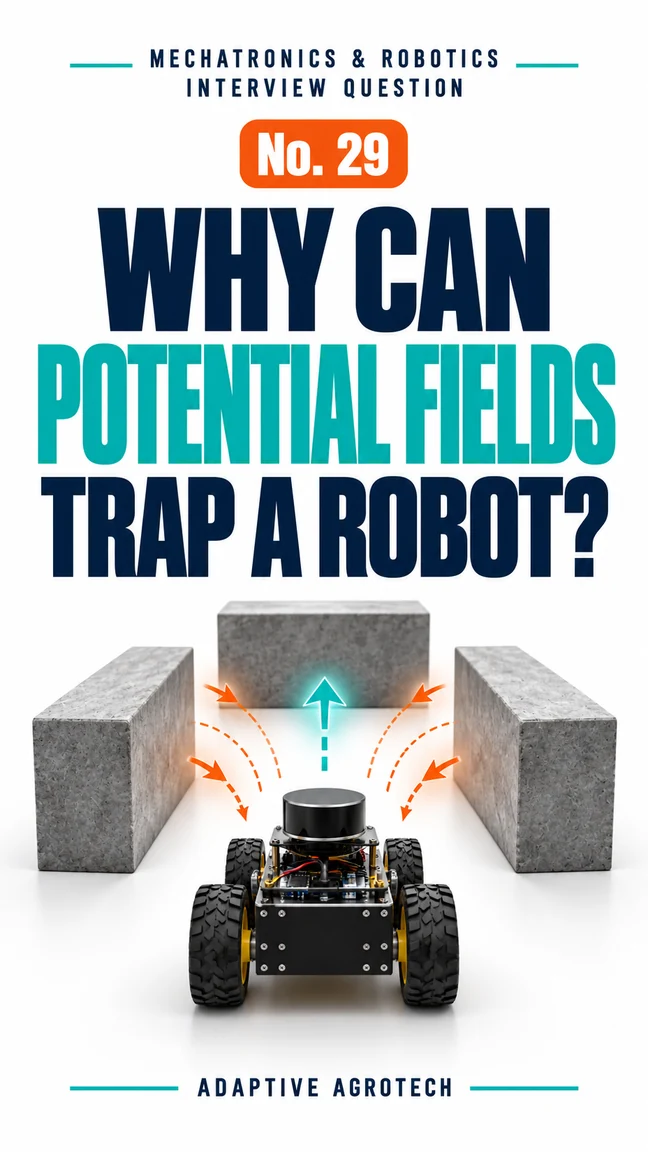
Artificial Potential Fields: Why a Robot Can Get Stuck
Artificial potential fields combine attraction toward the goal with obstacle repulsion. The negative gradient can guide inexpensive local motion, but competing forces may create a local minimum before the goal is reached.
The key idea
Potential-field navigation defines a virtual energy landscape. Goal attraction and clearance-dependent obstacle repulsion combine into a direction that can be converted into feasible robot commands. LiDAR observations can supply obstacle surfaces, and the negative potential gradient guides motion around them. Performance depends on gains, influence distance, and motion model. An obstacle between start and goal can balance attraction and repulsion, producing zero net force despite an available path around it. Intermediate waypoints from a global planner may change the attractive target and break a trap. This remedy still does not establish universal reliability or collision-free motion.
What to remember
- Motion follows combined attraction and obstacle repulsion.
- A zero gradient can occur at an unwanted local minimum.
- Global waypoints can help escape some potential-field traps.
Check your understanding
Does zero net potential-field force always mean the goal was reached?
Show the explanation
No. Attraction and repulsion can balance at a local minimum away from the goal.