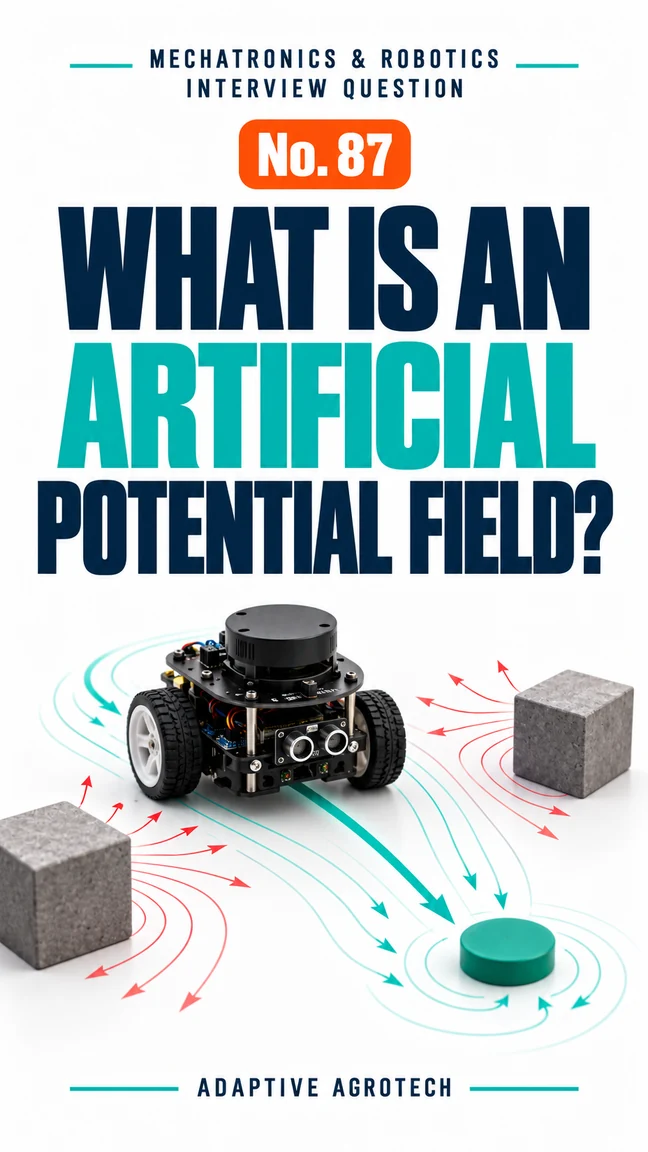
What is an Artificial Potential Field?
Artificial potential fields combine attraction toward a goal with repulsion from nearby obstacles. Following the resulting descent direction gives reactive motion, but opposing effects can cancel at a local minimum before the goal.
The key idea
An artificial potential field represents a navigation task as a landscape whose goal attracts the robot and whose nearby obstacles repel it. Motion follows the direction of decreasing potential. The attractive and repulsive effects combine as vectors: far from a wall, the goal may dominate, while increasing repulsion near the wall bends the motion away. A key limitation is a local minimum where these contributions cancel before the robot reaches its destination. The resulting zero gradient can stop progress, so waypoints or guidance from a global planner may be needed.
What to remember
- Combine goal attraction and obstacle repulsion.
- Move along the direction of decreasing potential.
- Local minima can stop motion before the goal.
Check your understanding
Why can a potential field trap a robot?
Show the explanation
Attraction and repulsion can cancel at a local minimum away from the goal.