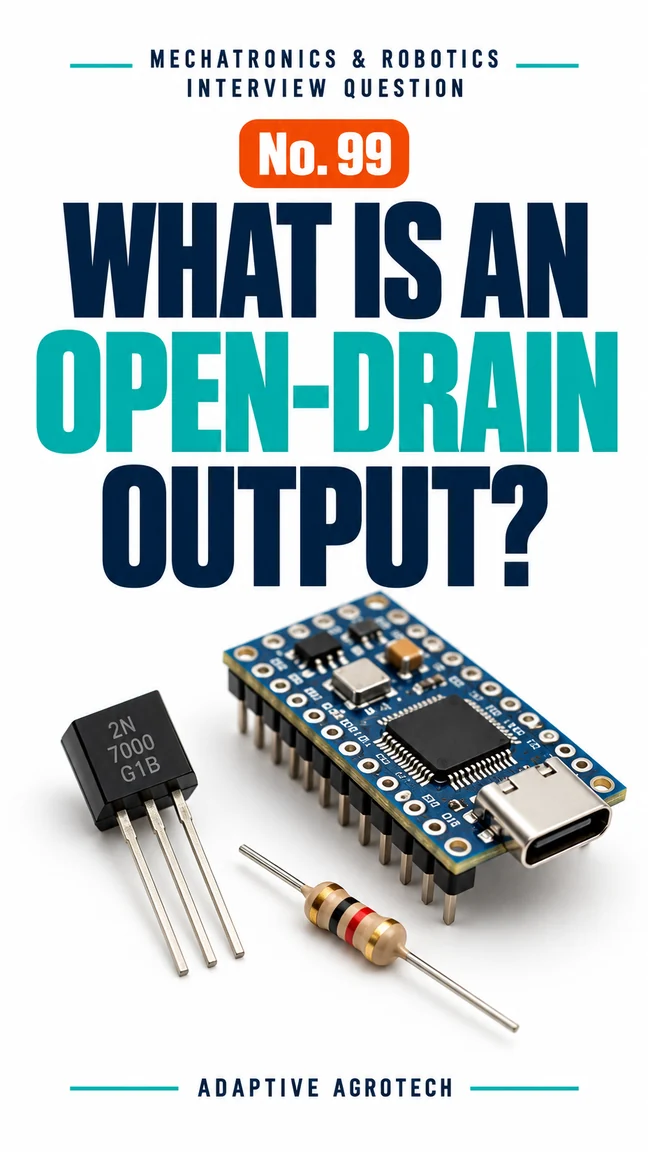
What is an Open-Drain Output?
An open-drain output either pulls a line low or releases it; an external pull-up supplies the high state. Compatible outputs can share a line, subject to voltage, sink current, and rise time limits.
The key idea
An open-drain output uses a transistor as a switch to ground. It can actively pull a signal low, but it does not actively drive the high level. When the transistor releases the line, a pull-up resistor raises the voltage. Several compatible outputs may share this arrangement because any active output can pull the common line low. A motor driver fault signal is one robotics example. The receiving circuit must use a permitted pull-up voltage and verify both the output’s sink current rating and the resulting signal rise time.
What to remember
- An open-drain output drives low or releases the line.
- A pull-up resistor creates the high level.
- Shared outputs need compatible voltage and current ratings.
Check your understanding
What produces the high level on an open-drain signal?
Show the explanation
The pull-up resistor raises the line when all connected outputs release it.