What is PWM?
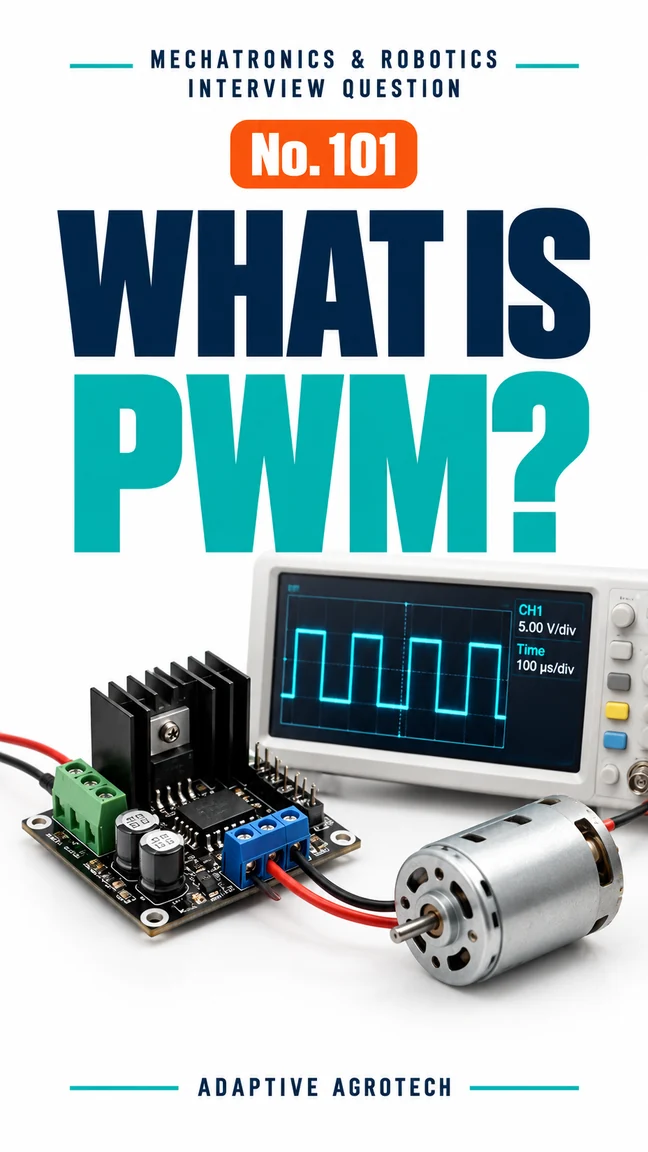
Pulse width modulation controls a switching signal’s on time within each period. Duty cycle affects average drive voltage, but actual motor speed also depends on current dynamics, load, and feedback control.
The key idea
PWM repeatedly switches a signal on and off at a chosen frequency. Duty cycle is on time divided by the complete period, describing the fraction spent on. In a simple ideal twelve volt switching stage, fifty percent duty gives six volts average output over a period. A motor driver uses these pulses to regulate delivered power, but motor current also depends on inductance, back EMF through speed, and load. Consequently, duty cycle alone is not a direct speed command. A speed controller can use encoder feedback to adjust duty as operating conditions change.
What to remember
- Duty cycle equals on time divided by period.
- Average voltage follows duty in an ideal switching example.
- Motor speed requires attention to load and feedback.
Check your understanding
Does fifty percent PWM duty guarantee fifty percent motor speed?
Show the explanation
No. Speed also depends on the motor, load, current dynamics, and feedback control.