What is Motor Stall Current?
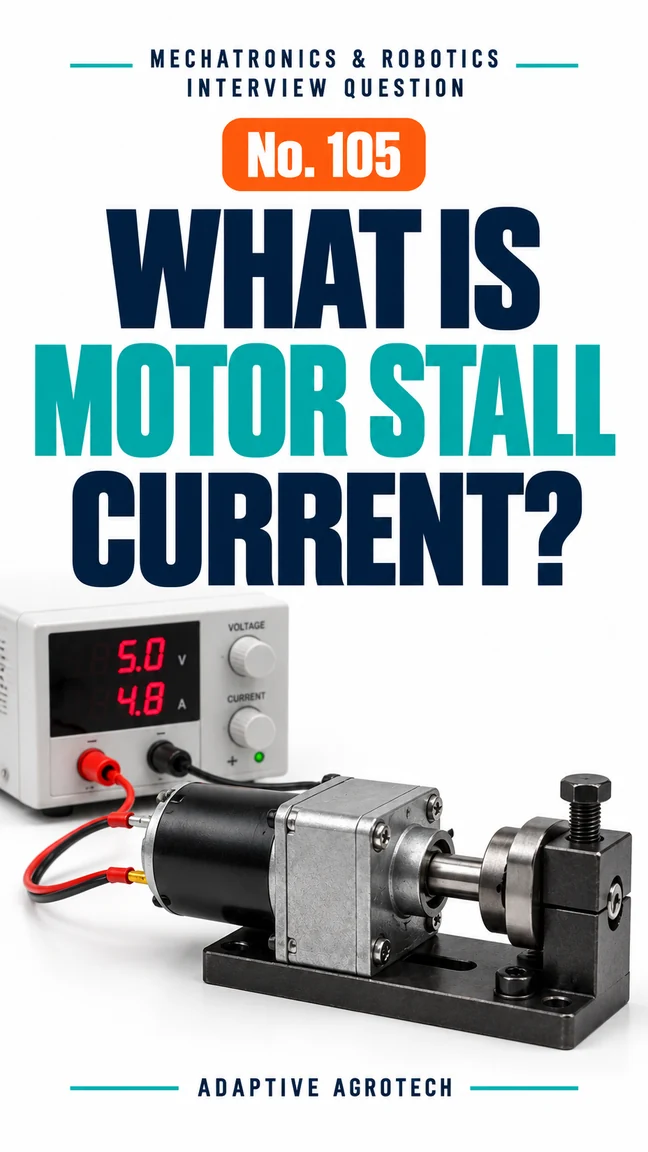
Motor stall current is measured with the shaft stopped at a stated voltage, where rotational back EMF is absent. It can greatly exceed a safe continuous current and requires stall detection and drive protection.
The key idea
With a brushed motor shaft stopped, rotational back EMF is zero. After the brief electrical transient, a simple unlimited model gives current approximately equal to applied voltage divided by winding resistance. A twelve volt supply across two ohms would therefore produce six amps. This stall current describes a specific stopped condition, not a safe continuous rating. A jammed robot wheel can heat quickly if the drive maintains that current. Current limiting and stall detection help protect the motor, while the drive electronics and wiring must accommodate the expected peak current.
What to remember
- At stall, rotational back EMF is zero.
- A simple settled estimate is voltage divided by winding resistance.
- Stall current must not be treated as a continuous rating.
Check your understanding
What is the illustrative stall current at 12 V and 2 Ω without limiting?
Show the explanation
Six amps after the brief electrical transient.