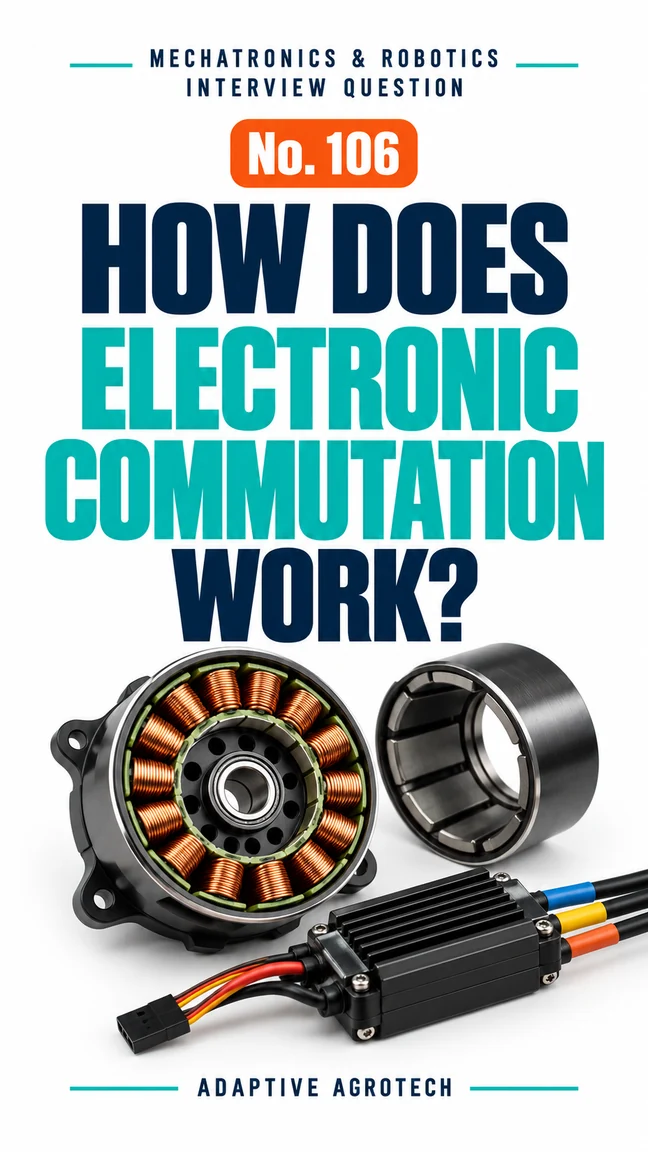
What is Electronic Commutation in a Brushless Motor?
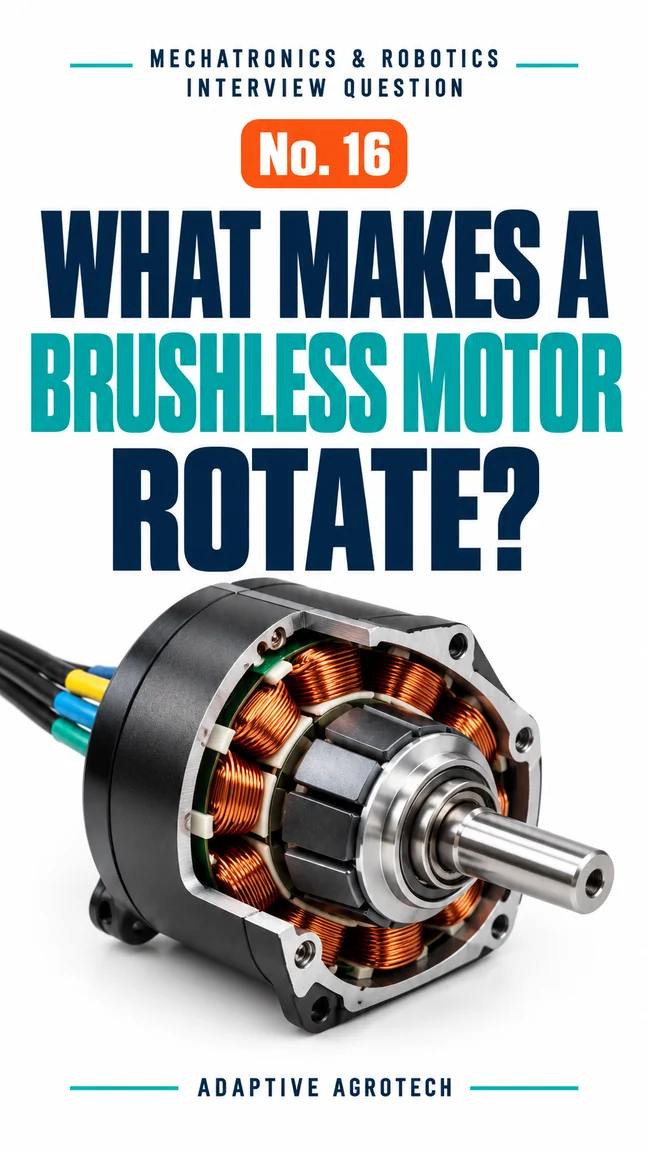
Electronic commutation switches brushless motor phase currents in relation to rotor angle. Sensors or electrical estimates provide timing, while weak back EMF near standstill creates a separate startup challenge for sensorless drives.
The key idea
A brushless motor drive times current in the stator windings according to rotor position, creating a rotating magnetic field that produces torque on the rotor magnets. The rotor angle may come from sensors or an electrical estimate. In a six-step scheme, six phase states occur per electrical cycle, and the number of pole pairs determines how electrical cycles relate to mechanical shaft turns. A robot’s outer speed loop requests torque, while commutation operates inside the drive. Back EMF based position estimation needs a startup strategy because its signal is weak near zero speed.
What to remember
- Time stator phase currents using rotor angle.
- Six-step commutation has six states per electrical cycle.
- Back EMF based sensing is weak near standstill.
Check your understanding
Why does back EMF based commutation need a startup strategy?
Show the explanation
The back EMF signal is weak near zero speed.