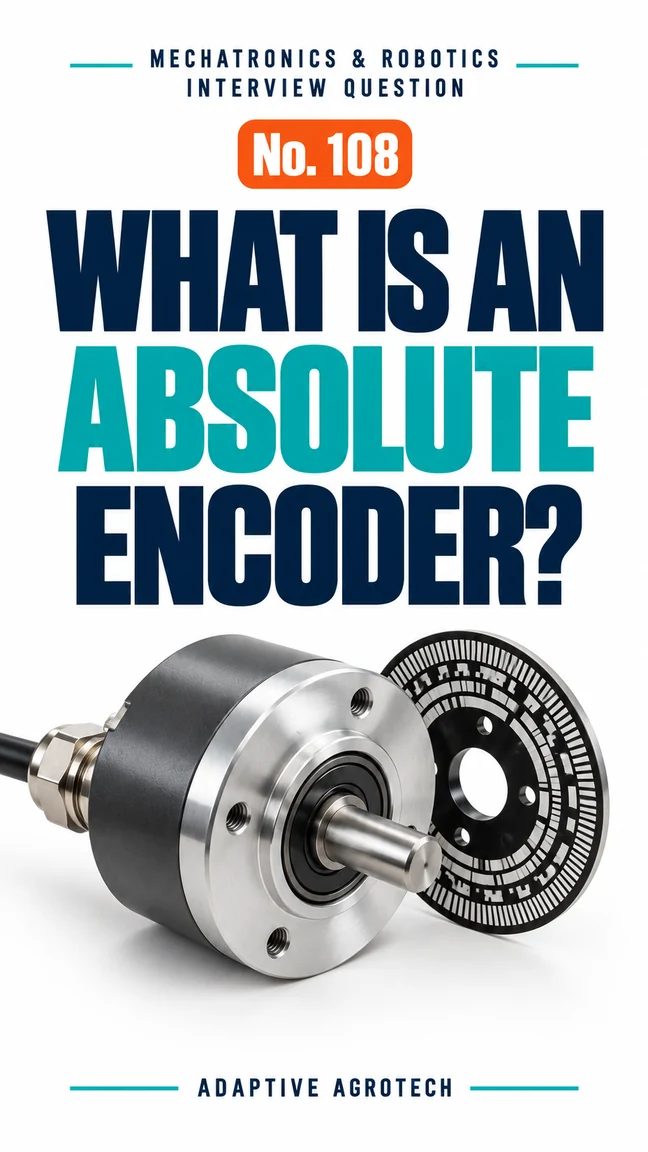
What is an Absolute Encoder?
An absolute encoder reports a position code that can identify shaft angle at startup. Single-turn and multi-turn devices differ, and useful joint measurements still require mounting, calibration, and an understanding of accuracy.
The key idea
An absolute encoder reports a code identifying shaft position rather than only incremental movement. A single-turn device reports angle within one revolution; a multi-turn device also tracks complete revolutions. This can let a robot joint report its angle immediately after restart without first moving to a reference. How multi-turn information survives power loss depends on the particular device. Selecting an encoder requires checking range, resolution, and accuracy. Correct mechanical mounting and calibration to the joint’s physical zero remain necessary, so a finely resolved code does not automatically imply an equally accurate joint measurement.
What to remember
- Position is represented by an absolute code.
- Single-turn and multi-turn encoders cover different ranges.
- Power loss retention, mounting, and calibration are device dependent.
Check your understanding
What additional information does a multi-turn encoder provide?
Show the explanation
It tracks complete shaft turns as well as the angle within a turn.