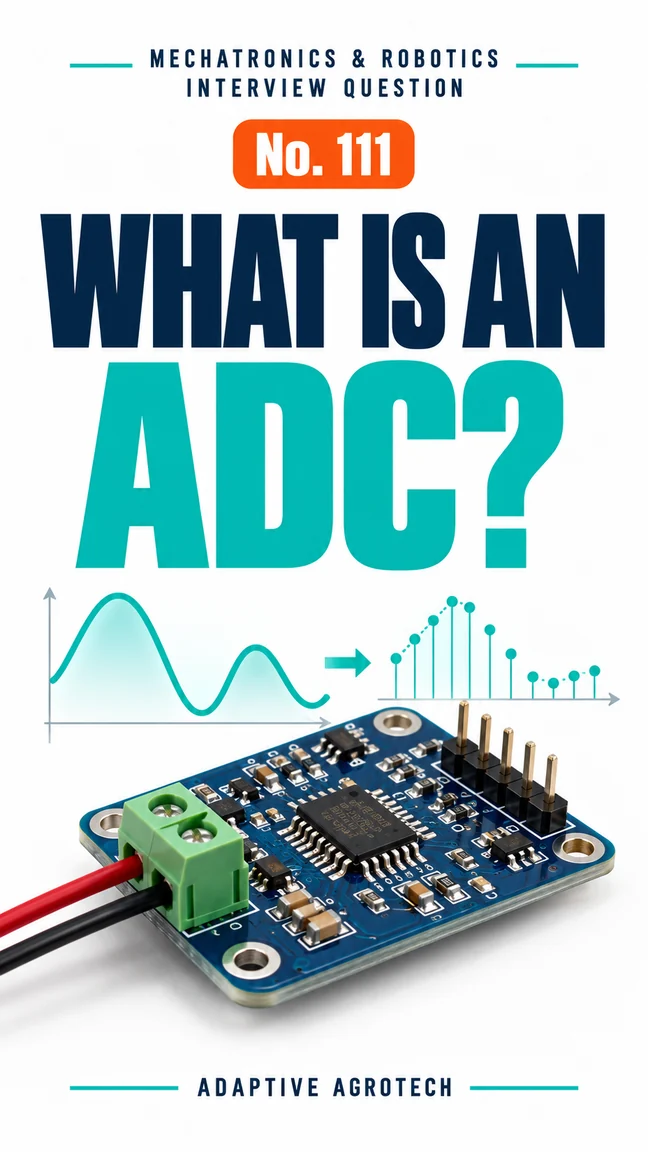
What is an Analog-to-Digital Converter?
An ADC converts sampled voltage into a digital code whose ideal spacing depends on reference voltage and bit depth. Practical precision also depends on noise, reference quality, input range, and sampling conditions.
The key idea
An analog-to-digital converter samples an input voltage and reports a number. Its reference determines the conversion range, while bit depth determines the number of ideal codes in that range. Across 3.3 volts, an ideal twelve-bit converter has 4,096 codes and a step of roughly 0.81 millivolts. A robot might use such a converter to read a current sensor. The input must remain in range and have enough sampling time. Additional bits cannot correct a noisy analog circuit or a poor reference, so code resolution and useful measurement accuracy must be distinguished.
What to remember
- Reference voltage sets the input conversion range.
- Bit depth determines ideal code count and spacing.
- Noise, reference error, and sampling conditions limit accuracy.
Check your understanding
What is the approximate ideal code step for 12 bits across 3.3 V?
Show the explanation
About 0.81 millivolts per code.