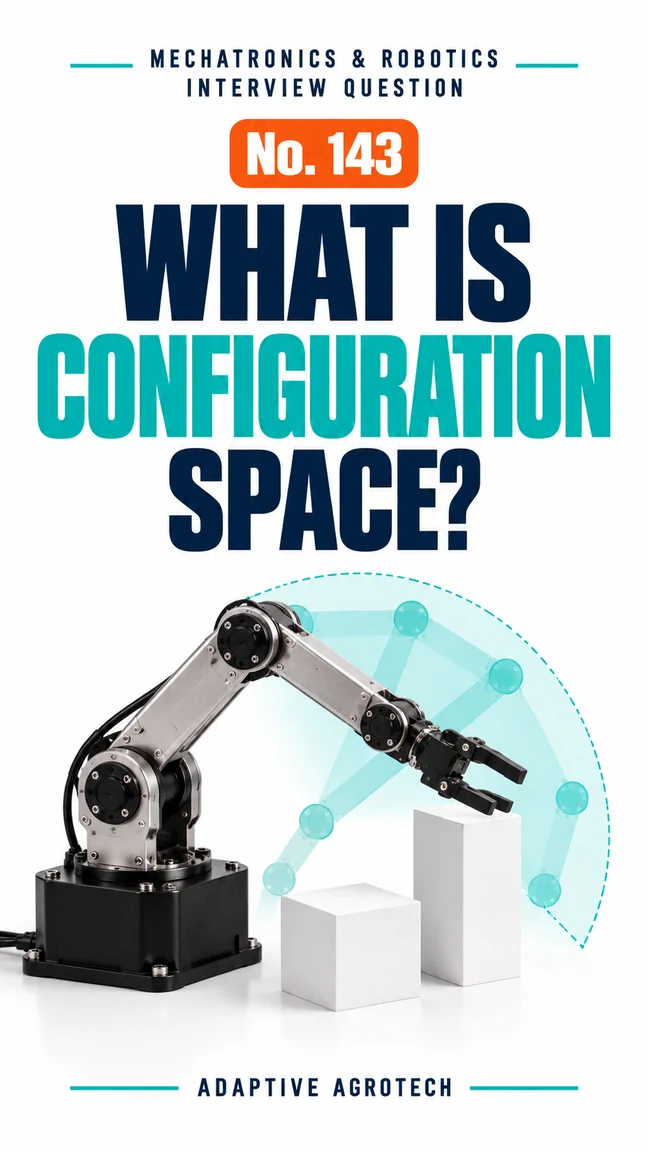
What Is Configuration Space in Robotics?
Configuration space represents the entire robot as a point whose coordinates locate its moving parts. Workspace obstacles become forbidden configuration regions, with joint limits and angular wrapping shaping the available planning space.
The key idea
A configuration provides the information needed to locate all moving robot parts. For a two revolute joint arm, two joint angles form a point in a two dimensional configuration space. As the arm moves, that point traces a path. A physical obstacle excludes every configuration where any robot link collides with it, even when the tool tip is elsewhere. Planning must therefore account for the whole mechanism rather than only a tool point. Joint limits constrain allowable regions, while revolute angle wrapping can make opposite plot edges represent neighboring configurations.
What to remember
- A configuration point describes the entire robot posture.
- Obstacles forbid sets of configurations where any link collides.
- Joint limits and angle wrapping affect space topology.
Check your understanding
Why is checking only the tool tip insufficient for configuration space planning?
Show the explanation
Other robot links can collide with an obstacle even when the tool tip is clear.