What Is a Control Barrier Function?
A control barrier function encodes an allowed region of state space. Its derivative condition restricts the control input so the state can remain inside. This differs from merely adding an obstacle penalty to a cost.
The key idea
A control barrier function encodes an allowed region of state space. Its derivative condition restricts the control input so the state can remain inside. This differs from merely adding an obstacle penalty to a cost.
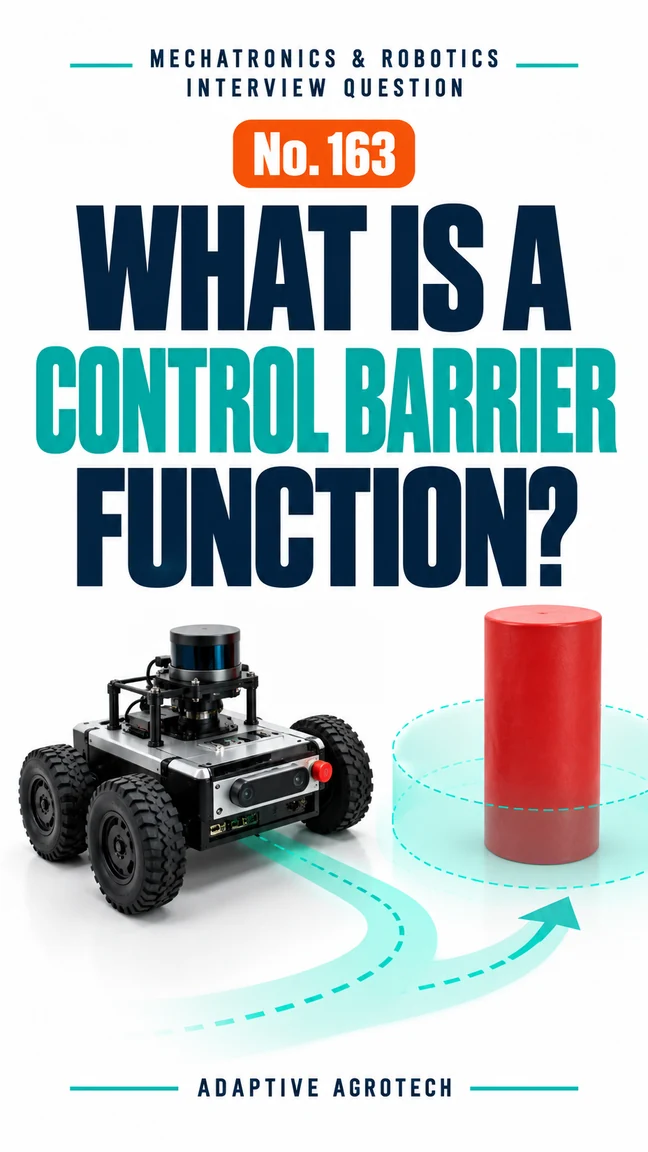
Consider a simple robot whose position rate equals its commanded velocity. As it approaches a forbidden boundary, the barrier condition restricts motion toward it. A small optimization can modify the requested command.
The conclusion depends on a valid model, a suitable barrier, feasible control limits, and correct implementation. Sampling and uncertain state estimates need treatment. A barrier function alone is not a certified physical protective system.
What to remember
- A state constraint becomes a control condition
- Filter the requested action before the boundary
- Model, feasibility, and timing support the guarantee
Check your understanding
What distinguishes a barrier condition from an obstacle cost penalty?
Show the explanation
A barrier condition restricts the allowable control input to preserve a defined state region under its assumptions. A cost penalty alone does not impose that invariant-state condition.