What Is Real-Time Jitter?
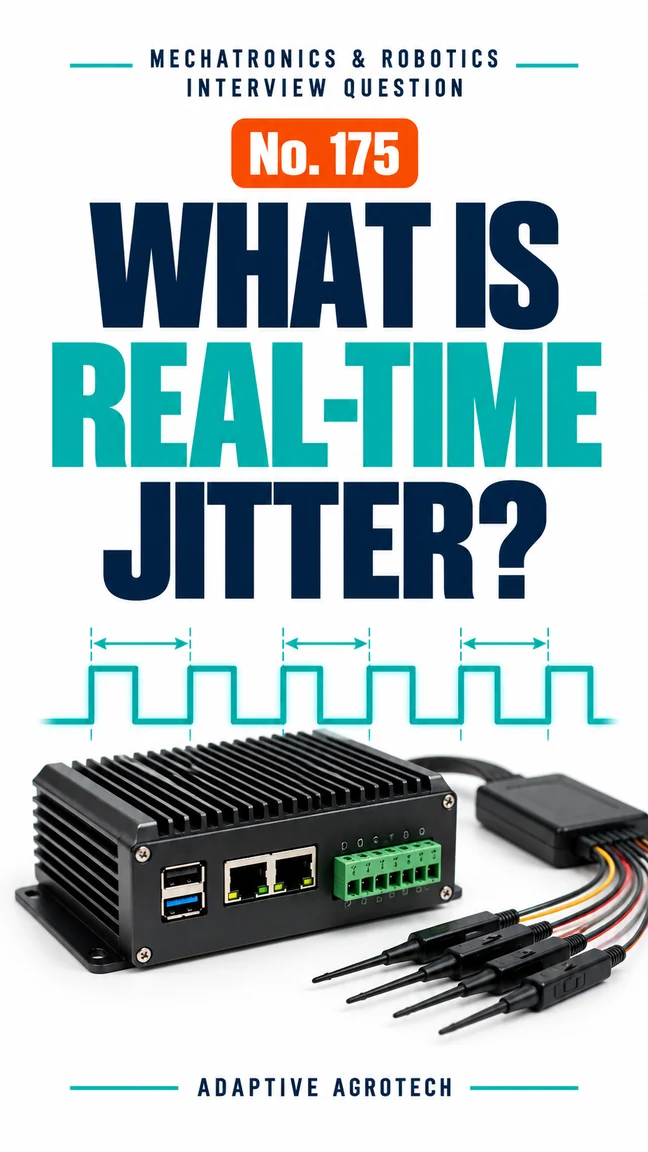
Real time jitter is variation in when a periodic task starts, finishes, or releases its output. A loop planned every millisecond can have irregular intervals even when its average frequency looks correct. Specify the event you measure.
The key idea
Real time jitter is variation in when a periodic task starts, finishes, or releases its output. A loop planned every millisecond can have irregular intervals even when its average frequency looks correct. Specify the event you measure.
For a balancing robot, late sensor processing means acting on an older state. If actual update intervals vary, a controller designed for a fixed interval can behave differently from its model, especially near its performance limits.
Record interval and latency distributions under realistic load. Avoid unbounded blocking and unexpected work in the critical path. Set allowable jitter from the application's dynamics and deadlines. One good average does not establish deterministic real time performance.
What to remember
- Average frequency hides timing variation
- Uneven updates change feedback behavior
- Measure worst case timing as well as the average
Check your understanding
Why can a loop with the correct average rate still perform poorly?
Show the explanation
Its update intervals can vary substantially. Jitter changes measurement age and feedback timing, so latency distributions, extremes and deadlines matter in addition to the average frequency.