What Is the Difference Between Trapezoidal and S-Curve Motion Profiles?
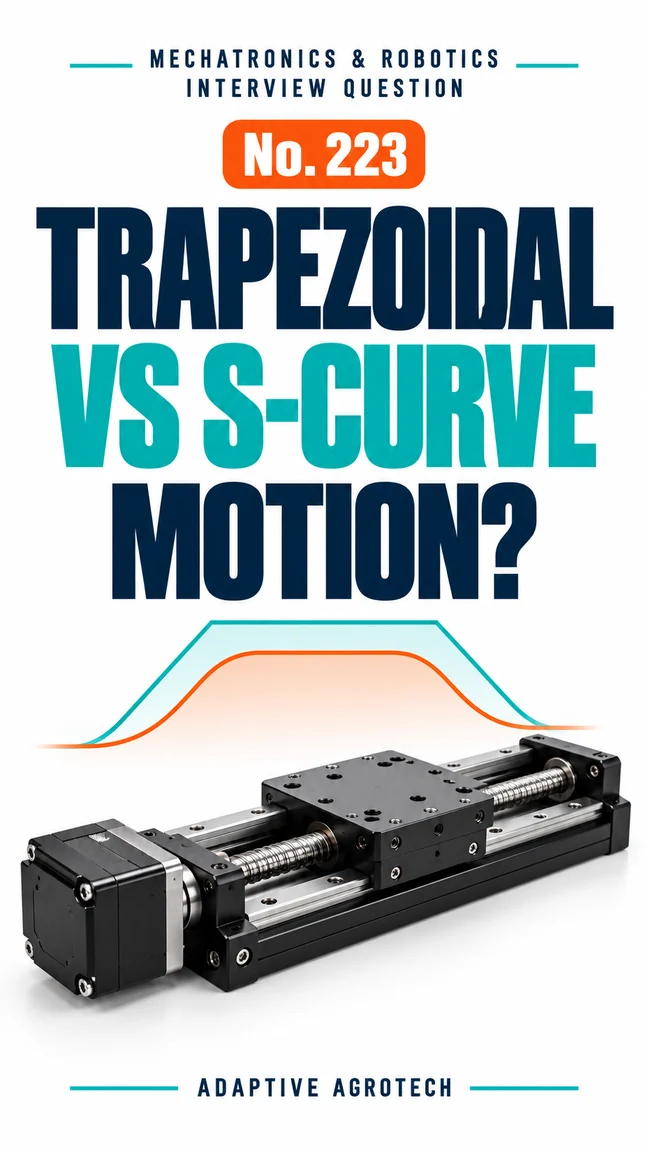
A trapezoidal velocity profile uses constant acceleration, constant speed, then constant deceleration. Its ideal acceleration changes instantly at the transitions. An S curve adds phases that change acceleration gradually.
The key idea
A trapezoidal velocity profile uses constant acceleration, constant speed, then constant deceleration. Its ideal acceleration changes instantly at the transitions. An S curve adds phases that change acceleration gradually.
Here both examples travel the same distance with the same peak speed and acceleration. The jerk limited move takes longer in this example, but gentler transitions can reduce excitation of a flexible robot axis.
The best choice depends on the mechanism. An S curve still has nonzero jerk, and smoother commands do not remove every vibration. Compare total travel and settling time under the real load.
What to remember
- S curves limit how quickly acceleration changes
- Compare distance and limits before comparing time
- Optimize the complete move, including settling
Check your understanding
Why can an S-curve take longer yet improve the complete move?
Show the explanation
Gradual acceleration transitions can reduce excitation of flexible mechanisms. Compare equal travel and limits, then include settling time rather than judging only peak speed or travel time.