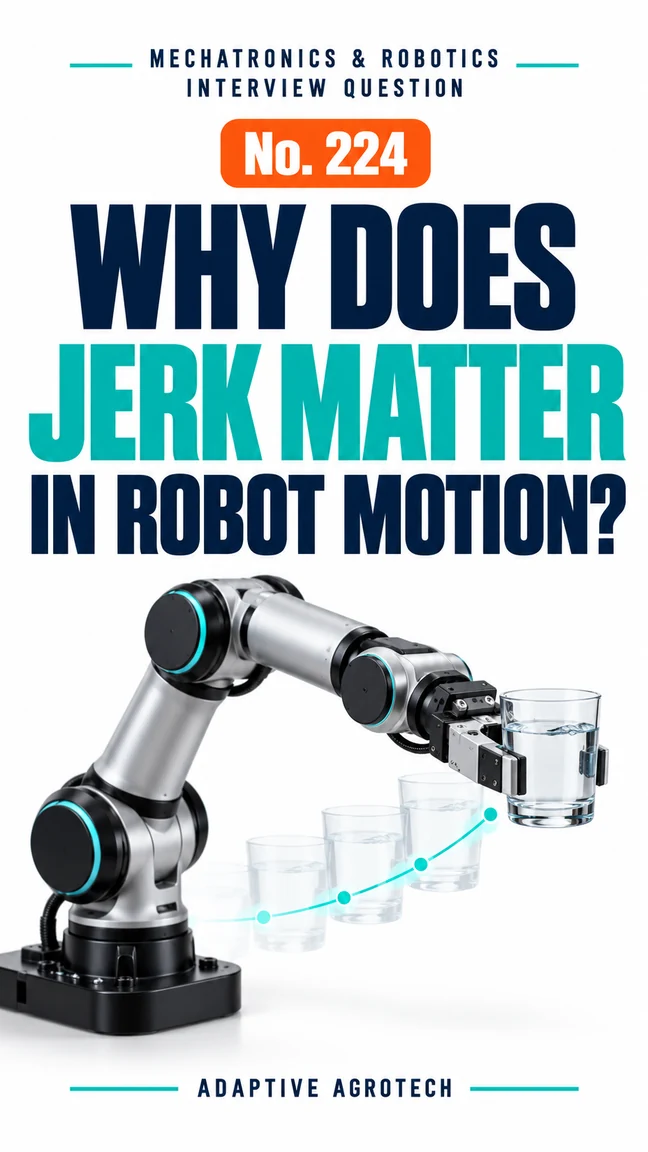
What Is Jerk, and Why Does It Matter in Robot Motion?
Jerk is the rate of change of acceleration. Position gives velocity, velocity gives acceleration, and acceleration gives jerk. For linear motion, jerk has units of meters per second cubed.
The key idea
Jerk is the rate of change of acceleration. Position gives velocity, velocity gives acceleration, and acceleration gives jerk. For linear motion, jerk has units of meters per second cubed.
If acceleration rises by two meters per second squared in one tenth of a second, average jerk is twenty meters per second cubed. Spreading that change over more time reduces average jerk.
Abrupt acceleration changes can excite vibration in a robot arm or its payload. A jerk limit makes the motion command gentler, but usable limits depend on actuator capacity, structural dynamics, and tracking accuracy.
What to remember
- Jerk = change in acceleration / change in time
- The example has average jerk of 20 m/s³
- Limit jerk while checking motion and load constraints
Check your understanding
What is the average jerk when acceleration rises by 2 m/s² in 0.1 s?
Show the explanation
Average jerk is 20 m/s³. Spreading the acceleration change over more time reduces average jerk, while feasible limits depend on the actuator, structure, payload and tracking needs.